
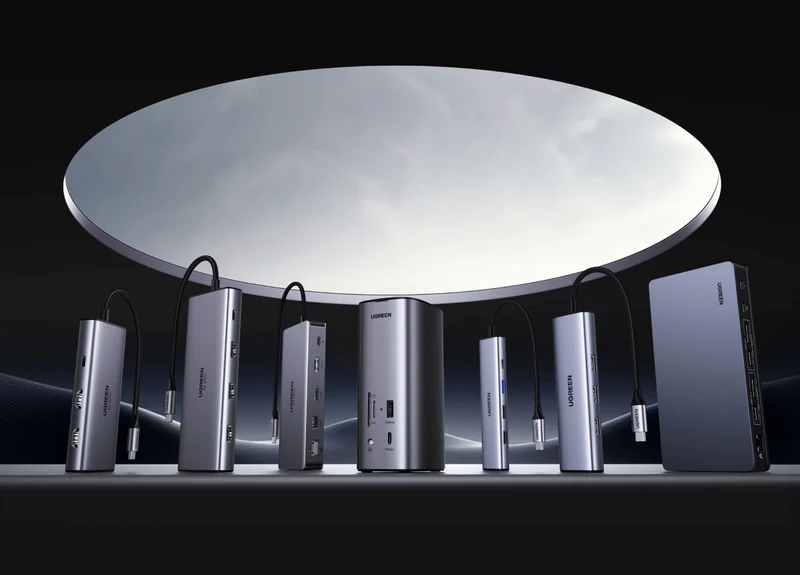
For years, expansion accessories were framed in a simple way. Laptops got thinner, ports disappeared, and users needed a way to connect everything back again. In that context, the solution sounded obvious. Add more ports, restore basic functionality, and move on.
That logic still exists, but it no longer explains why these products matter as much as they do. Today, people are not only trying to solve a hardware limitation. They are trying to make work feel more continuous from one moment to the next. The real value of expansion gear is less about how many ports it adds and more about how smoothly it helps a user move through the day.
That is why the conversation is shifting from port expansion to workflow continuity.
Continuity is a different standard from capacity. A device may offer plenty of connections on paper and still do very little to improve the actual experience of working. What matters in practice is whether it reduces interruption. Does it help a laptop move into a full workspace quickly. Does it make transitions between tasks feel simpler. Does it lower the number of small adjustments that break focus before work even begins.
Those small adjustments are often the real problem. They rarely seem serious on their own. A monitor does not reconnect immediately. An external drive needs a separate cable from the power line. A user has to unplug a keyboard from one machine and reconnect it to another. After a meeting in another room, the desk has to be rebuilt again. None of these moments sounds dramatic, but together they create friction. Over time, that friction shapes the pace of a workday more than people expect.
This is where expansion accessories have become more important than they used to be. A usb hub is no longer just a backup tool for someone who suddenly needs an extra port while traveling. In many setups, it plays a much more active role. It helps people keep a lightweight workflow intact when they are moving between locations, using temporary desks, or building a flexible setup around a laptop that changes roles throughout the day. The value is not just in adding access. It is in keeping momentum.
The same is even more true of a laptop docking station. It is easy to describe it as a device that connects a monitor, charger, mouse, Ethernet cable, or storage drive through a simpler interface. But that description misses what users often care about most. The real benefit is that it turns connection into a routine rather than a repeated task. A laptop arrives at the desk, one action happens, and the larger workspace becomes available in a familiar way. That predictability is what supports continuity.
This matters because the modern desk is no longer built around one fixed pattern of work. A single day may involve focused solo tasks, video calls, file transfers, writing, design work, charging multiple devices, and shifting between personal and professional use. Even the location may change. Someone might start in a home office, take the laptop to another room for a call, then return to a more complete workstation later. In that kind of environment, a smooth setup is not a luxury. It is part of staying mentally organized.
Feature-first thinking often misses this point. It encourages people to compare products by asking which one has more ports, more slots, more display outputs, or more technical reach. Those details are not meaningless, but they are not the whole story. A person can buy a highly capable accessory and still end up with a setup that feels awkward if the product does not match the rhythm of their work. More options do not always mean less friction.
That is why workflow continuity has become such a useful lens. It shifts the question from “What can this accessory do?” to “What kind of day does this accessory make easier?” That is a much more revealing question. A user who needs a light, adaptable setup for changing spaces may get more value from a compact usb hub than from a larger desktop-oriented solution. Another user who depends on an external monitor, power delivery, wired internet, and a stable desk environment may benefit far more from a laptop docking station that stays in place and supports repeatable connection every day.
In both cases, the winning product is not necessarily the most complex one. It is the one that makes the working environment feel more coherent. Good expansion gear should not only restore lost connectivity. It should reduce decision fatigue. It should make it easier to return to work after a break, a meeting, or a location change. It should support the idea that tools in a workspace are there to remove friction, not create new forms of management.
This also explains why people increasingly describe the best desk setups in terms like clean, fast, stable, ready, or easy to return to. Those words are not just about aesthetics. They reflect a deeper expectation that a workspace should hold together across repeated changes in attention and activity. Continuity is what makes a desk feel dependable, and dependable environments usually support better work.
Seen that way, expansion devices are no longer minor accessories sitting at the edge of the workspace. They are part of the connection layer that determines how quickly a person can move from intention to action. That layer becomes especially important when laptops are used as flexible, mobile computers that still need to plug into richer environments at the right moments.
In the end, the shift from port expansion to workflow continuity says something important about how modern work has changed. People are no longer just trying to connect more things. They are trying to stay in flow across devices, tasks, and spaces. The tools that matter most are the ones that support that flow quietly and consistently. Once that becomes the goal, expansion gear stops being about ports alone and starts becoming part of how a workday holds together.

At Engrnewswire, we are passionate about helping brands grow through smart SEO, GEO, and AEO strategies, supported by High-quality backlinks. With over 2k+ contributor accounts worldwide. We ensure your content reaches the right audience while building lasting authority.