
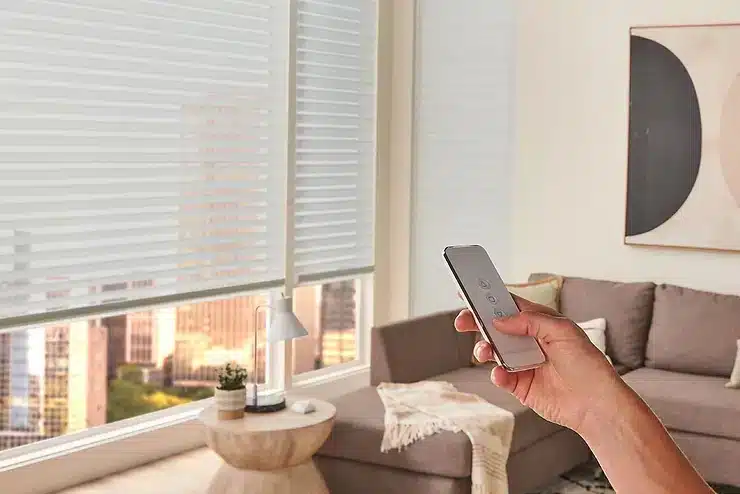
Most people don’t think about their window blinds much. Until something forces the issue. A toddler reaching for a cord. A bedroom that fills with light too early. A skylight nobody can reach without a stepladder. Then suddenly, motorized options start looking pretty appealing.
There’s a whole category of motorized window coverings now that handle the lifting and lowering without anyone touching a cord. Some run on remotes, some on apps, some on voice commands. The tech isn’t new exactly, but the price point has dropped enough that it’s no longer a luxury-only purchase.
If you’ve been curious about what these things do, here’s a plain-English rundown. Quick note up front: when shopping, you’ll see them labeled “motorized,” “smart,” or “remote-controlled” blinds. Mostly the same product family, with different marketing names depending on the retailer.
What They Are
A small motor sits inside the headrail, the top piece of the blind or shade. It moves the slats or the fabric up and down or tilts the slats open and closed.
Power comes from one of three sources:
- Rechargeable batteries. Easiest to install.
- Hardwired into your home’s electricity. Cleaner look, more work.
- Solar panel mounted on the window. Best for shades that get direct sun.
You operate them with a small handheld remote, a wall switch, an app on your phone, or your voice through a smart speaker. Some setups use more than one of these at the same time.
The motor is very quiet on better models. On cheaper ones, you’ll hear a soft hum.
Why People Get Them
A few reasons come up over and over.
Tall or hard-to-reach windows
If you have skylights, transom windows, or anything above a staircase, motorization is honestly the only practical option. Climbing on furniture to adjust a shade gets old fast.
Convenience for daily routines
Setting blinds to open at 7 a.m. and close at sunset means you stop thinking about them entirely. Same with movie nights. Press one button and four shades drop together.
Safety with kids and pets
The U.S. Consumer Product Safety Commission has been pushing cordless products for years because of strangulation risk, and the Window Covering Safety Council explicitly recommends cordless options in any home with young children. Most motorized blinds eliminate exposed operating cords entirely.
Accessibility
For older homeowners or anyone with mobility limitations, being able to raise and lower window coverings without standing up or reaching is genuinely useful.
Aesthetics
No cords, no chains, no wand. The window just looks cleaner.
What to Think About Before Buying
A few things worth knowing.
Battery life varies a lot. Cheaper motors might need recharging every few months on a heavily used window. Better systems can run for a year or more between charges. Worth checking the spec sheet before buying.
App quality matters more than people expect. Some manufacturer apps are clunky and laggy. Others integrate cleanly with Apple Home, Google Home, or Alexa. If you already have a smart home setup, check compatibility first.
Hardwired vs. battery-powered is a real choice. “Hardwired” means no batteries to swap, but it usually requires running new electrical (and possibly an electrician). Battery models are simpler, but you’ll deal with charging at some point.
Scheduling is the actual upgrade. The remote is fine on its own. But the moment you set up a schedule and forget about it, you realize what people mean when they say motorized blinds change how you live with windows.
Cost Ballpark
Pricing is hard to pin down because it shifts with fabric, size, smart integrations, custom dimensions, and installation. As a rough guide, though:
- Entry-level motorized roller shades typically start around $150 to $250 per window
- Mid-range cellular shades with smart home compatibility often run $300 to $600
- High-end designer brands with full home integration can push past $1,000 per window, sometimes well past
Custom retailers and direct-to-consumer brands now offer motorized options at far lower prices than early smart home systems, which is part of why the category has opened up.
If you’re outfitting a whole house, the math adds up fast. Most people start with one or two windows where it makes the biggest difference (bedroom for the wake-up routine, living room for the movie-night use case) and expand from there.
What to Skip
The cheapest no-name options off marketplaces tend to disappoint. Loud motors, flimsy remotes that lose signal, batteries that die after a few months. The category has real budget options, but going too cheap usually means buying twice.
Also worth skipping: the assumption that you need everything to be smart. Sometimes a wall switch and remote are a better answer than another app on your phone.
So Are They Worth It?
Depends on the windows and the household. For a single window in a guest bedroom you barely use, probably not. For tall windows you can’t easily reach, for homes with young kids, or for daily routines you’d rather automate, the answer leans pretty firmly toward yes.
The technology is more reliable and accessible than it was even a few years ago. Setup is simpler. And the price point is no longer absurd.
For many households, the biggest surprise isn’t the remote control. It’s how quickly automated blinds disappear into the background once they’re part of a routine. That’s when the upgrade actually pays off.
