

Morta.com has spent the past several years building software around a simple observation: property developers do not suffer from a shortage of information. If anything, the opposite is true. Every project generates an overwhelming volume of financial data, procurement records, consultant correspondence, planning documentation, board reports, programme updates, contractual obligations, and stakeholder requests. The challenge has never been collecting information. The challenge has been turning that information into action before opportunities disappear or problems become expensive.
The arrival of artificial intelligence has intensified this conversation. Over the past two years, developers have watched AI move from a specialist technology discussed within technical circles to something that appears in almost every software demonstration, conference presentation, and boardroom discussion. Yet beneath the excitement lies a growing distinction that is beginning to shape how businesses think about the future of work. Not all artificial intelligence is attempting to solve the same problem.
Much of the AI that has entered the mainstream belongs to a category now commonly referred to as generative AI. These systems are designed to create content. They can draft emails, summarise documents, answer questions, write reports, and generate text in a matter of seconds. Their capabilities are impressive, and their influence on professional work is already significant. However, for industries such as property development, where decisions carry substantial financial consequences and workflows extend across multiple departments, content generation may only represent the beginning of a much larger shift.
A different category of artificial intelligence is beginning to emerge. Rather than simply responding to prompts, these systems are designed to perform tasks, make decisions within defined parameters, and execute actions across connected workflows. The term increasingly used to describe this evolution is agentic AI, and it may have profound implications for the way property developers operate.
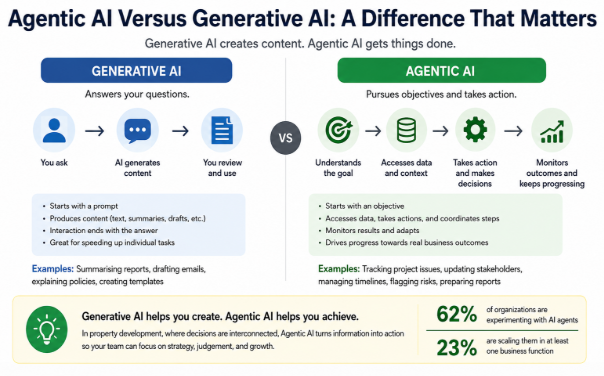
Agentic AI Versus Generative AI: A Difference That Matters
The distinction between generative AI and agentic AI may appear technical at first glance, but it has practical consequences for every development business.
Generative AI excels at producing outputs. Ask it to summarise a feasibility study, draft a procurement email, explain planning policy, or create a board report template, and it can provide a response almost instantly. The interaction begins with a prompt and ends with an answer. It is remarkably effective at accelerating tasks that would otherwise require manual effort.
Agentic AI approaches the problem differently. Rather than focusing solely on generating information, it is designed to pursue an objective. It can access data, interpret context, execute actions, monitor outcomes, and continue working towards a goal without requiring constant instruction from a user. The difference is subtle in theory but substantial in practice.
Consider the way many professionals currently interact with artificial intelligence. A development manager might ask an AI assistant to summarise a project report. The report is generated, reviewed, and the interaction ends. An agentic system would approach the same situation from a broader perspective. It might identify issues within the report, compare them against procurement timelines, flag potential budget concerns, notify relevant stakeholders, and prepare supporting information for a future decision. The output is not merely a piece of content. It is progress towards an operational objective.
This distinction becomes increasingly important within property development because development itself is not a collection of isolated tasks. It is a network of interconnected decisions that stretch across acquisitions, appraisals, planning, procurement, delivery, funding, and reporting. Information rarely exists in isolation, and neither do the consequences of decisions.
For years, software has primarily functioned as a repository. Teams entered information, retrieved information, and used that information to make decisions. Generative AI improved the experience by making information easier to access and understand. Agentic AI introduces a different possibility altogether. The system becomes an active participant within the workflow rather than a passive container of information.
The implications extend beyond productivity alone. They touch upon the way organisations allocate time, manage risk, and structure operational processes. As businesses become more complex, the ability to delegate certain forms of coordination and analysis to intelligent systems becomes increasingly valuable.
Property development is particularly well-positioned for this shift because so much of the work revolves around connecting information from multiple sources. Development teams spend significant portions of their time gathering data, verifying its accuracy, identifying dependencies, preparing reports, following up on actions, and ensuring stakeholders remain aligned. These activities are essential, but they rarely represent the highest-value use of experienced professionals.
The emergence of agentic AI suggests a future where more of this coordination can happen continuously in the background, allowing teams to focus their attention on judgement, strategy, negotiation, and decision-making. This is already taking shape, with 62% of organizations experimenting with AI agents, and 23% scaling them in at least one business function.
What Agentic AI Means for Property Development Workflows
The introduction of agentic AI into property development software arrives at a moment when the industry is already experiencing increasing complexity. Projects are becoming larger, funding structures are becoming more sophisticated, reporting expectations continue to grow, and stakeholders expect greater transparency throughout the development lifecycle. At the same time, development teams are under pressure to move quickly without sacrificing control.
This environment creates an ideal use case for intelligent systems capable of operating across connected workflows.
Consider a typical development project. An appraisal informs acquisition decisions. Acquisition decisions influence funding requirements. Funding structures affect procurement strategies. Procurement activity impacts programme timelines. Programme performance influences commercial outcomes and stakeholder reporting. Every stage relies on information generated elsewhere in the process.
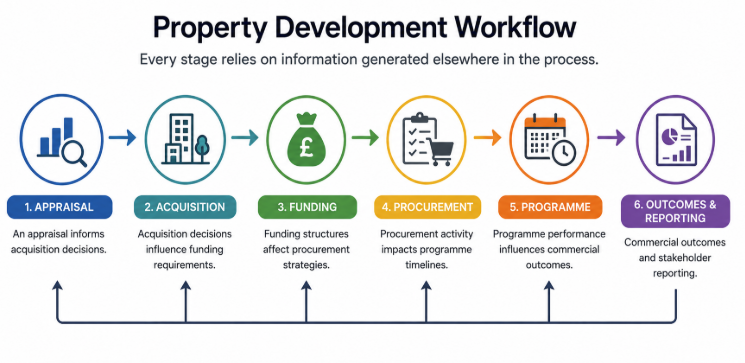
Historically, managing these relationships has depended heavily on human coordination. Teams gather information from multiple sources, interpret its significance, and distribute it to the appropriate people. While technology has improved visibility, much of the responsibility for connecting the dots still rests with individuals.
Agentic AI introduces the possibility of a different operating model. Instead of waiting for someone to request information, intelligent systems can monitor developments as they occur. Instead of relying on manual follow-up, they can identify actions that require attention. Instead of requiring teams to assemble information from different locations, they can surface relevant context automatically as decisions are being made. This shift is already underway: today, 24% of executives say AI agents take independent action in their organizations, and by 2027, 67% expect that to be the case.
For property developers, this could fundamentally alter the rhythm of daily work.
Board reporting, for example, has traditionally involved gathering information from multiple departments before compiling it into a format suitable for review. Agentic systems could continuously assemble and update relevant information, reducing the effort required to prepare reports while increasing confidence in their accuracy.
Procurement workflows may evolve in a similar way. Rather than relying entirely on manual oversight, intelligent systems could track tender activity, identify bottlenecks, surface supplier risks, and ensure key milestones are not overlooked. The objective is not to replace human judgement but to ensure decision-makers spend less time searching for information and more time evaluating it.
Financial oversight presents another significant opportunity. Development businesses operate within a landscape where small changes can have substantial consequences. Variations, procurement decisions, programme adjustments, and commercial assumptions all influence project performance. Agentic AI has the potential to identify patterns and relationships that would otherwise require considerable manual analysis, helping teams recognise emerging issues earlier than traditional reporting methods allow.
The broader significance lies in how these capabilities reshape the role of software itself.
For decades, property development software has primarily been used to record what has happened. More recently, it has become a tool for understanding what is happening. Agentic AI introduces the possibility that software can help organisations anticipate what is likely to happen next and assist in coordinating an appropriate response.
That represents a meaningful evolution for the industry.
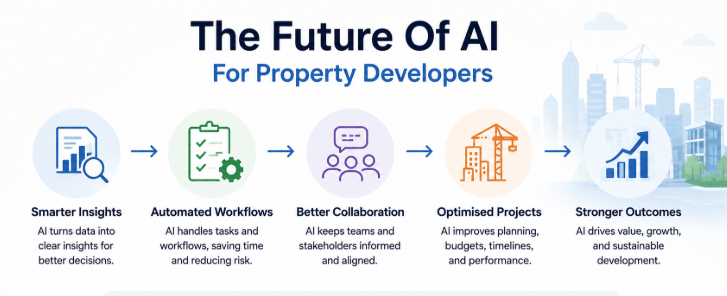
The Future Of AI For Property Developers
The conversation surrounding AI for property developers is often dominated by questions about automation. Will artificial intelligence replace jobs? Will it eliminate certain administrative functions? Will it reduce the need for particular roles?
These questions are understandable, but they may overlook a more important shift.
Throughout history, the most transformative technologies have rarely succeeded because they removed people from the equation. They succeeded because they changed how people spent their time. Spreadsheets did not eliminate finance professionals. They allowed them to focus on analysis rather than arithmetic. Email did not eliminate communication. It accelerated it.
Agentic AI appears likely to follow a similar path.
Within property development, the greatest value may not come from replacing professionals but from reducing the amount of effort spent coordinating information across increasingly complex businesses. Development teams will still make decisions. They will still negotiate, assess risk, manage relationships, and exercise judgement. What changes is the amount of time required to assemble the information that supports those activities.
This is one reason why the emergence of agentic AI is particularly significant within the context of an ERP for property developers. Enterprise systems already contain the information required to understand a business. The next logical step is enabling that information to work more actively on behalf of the people using it.
For companies seeking a competitive advantage, the question may soon become less about whether they use artificial intelligence and more about how deeply that intelligence is integrated into their operating model.
Platforms such as Morta.com are positioning themselves at the centre of this transition by exploring how agentic AI can support the entire development lifecycle rather than individual tasks alone. As the technology matures, its influence is likely to extend far beyond document generation or simple automation. It may become an operating layer that sits across the business, helping teams move from information to action with greater speed and confidence.
For property developers, that prospect is particularly compelling. An industry built on complex decisions has always depended on having the right information at the right time. Agentic AI changes the conversation by introducing a new possibility: what happens when the system itself helps ensure that information reaches the people who need it before they even ask for it.
Developers interested in seeing how this evolution is taking shape can book a demo with Morta.com and explore how agentic AI is being applied within modern property development workflows.
