
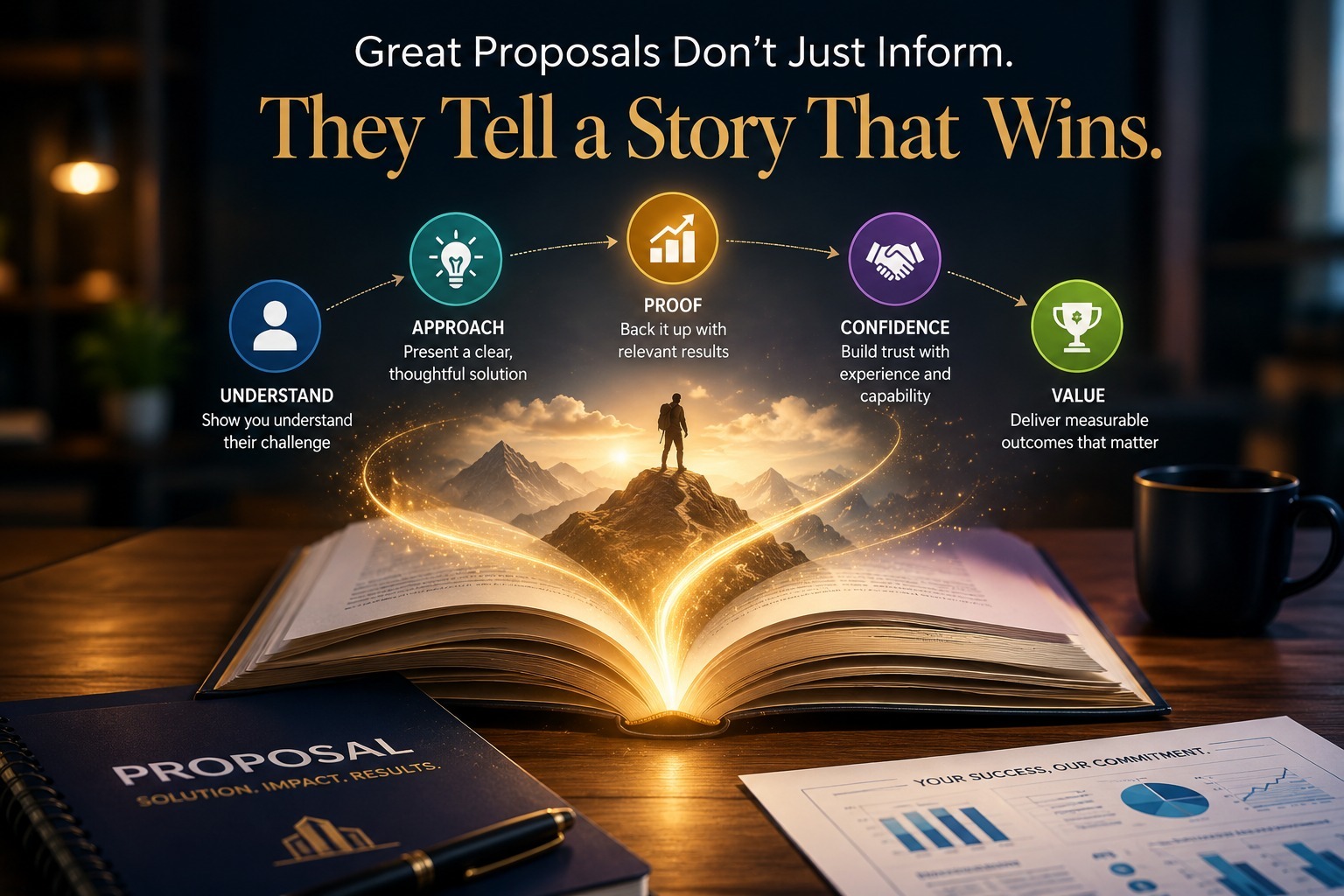
Nobody teaches proposal writers to think like storytellers, yet the evidence for doing so is everywhere. The submissions that score highest and stay with evaluators long after the review ends are almost never the most technically dense. They are the ones that make the evaluator feel something: reassurance and confidence. They do this by doing what good stories have always done — creating a clear structure, building toward a conclusion and making the reader feel that they are in capable hands.
The Problem With Pure Information
A proposal written purely to convey information will meet the requirements and leave the reader cold. Information answers the question. The story answers it and makes the reader care.
Harvard Business Review has documented that humans are hardwired to respond to narrative — that story reaches audiences in ways that facts and data alone cannot replicate, because the brain processes structured narrative differently from raw information. This is not a soft creative preference. It reflects how attention and memory actually work. A reader who is engaged by a compelling sequence of ideas will absorb more, trust more and remember more than one who is simply processing a checklist.
When an organisation describes a past project by listing what was done, it passes. When it describes the challenge, the stakes, the approach chosen and the outcome achieved, it persuades. The reader begins to picture the organisation working on their problem, and that picture is the beginning of trust. Two proposals can contain identical facts. The one that arranges those facts into a coherent, purposeful narrative will consistently outperform the one that does not.
Structure as the Reader’s Guide
Good storytelling is inseparable from good structure. A reader who can orient themselves within a document — who understands where they are in the argument and what is coming next — will engage more deeply and retain more of what they read.
This is why structure in a proposal is never merely an administrative requirement. It is an act of hospitality toward the evaluator. A document that forces the reader to search for the thread and work backwards through sections to understand why something was included creates friction. Friction kills confidence. The evaluator begins to wonder, consciously or not, whether the same disorganisation will characterise the proposed work.
Proposals that open with a clear statement of understanding, build through a well-sequenced response and close with a confident summary of value give the evaluator a journey rather than a document to be scanned and scored. Each section should feel like a natural continuation of the last. Headings should signal progress, not just label content. By the time the reader reaches the conclusion, they should feel that the argument has been building steadily toward an answer they were already beginning to anticipate.
The Voice That Builds Confidence
There is a particular quality of voice in the strongest proposals: clear, direct and assured without being arrogant. It speaks to the client rather than about the client. It uses language that reflects an understanding of the client’s world rather than defaulting to the organisation’s internal jargon. This voice does not happen accidentally. It is crafted deliberately, shaped by someone who understands that every sentence either builds confidence or erodes it.
The difference is often subtle but always felt. A sentence that begins “We have extensive experience in…” turns the reader’s attention inward. A sentence that begins “Your project requires…” or “What this means for your timeline is…” orients the reader toward their own situation and positions the writing organisation as a guide rather than an applicant. That shift in orientation — from self-presentation to client-focus — is one of the most reliable indicators of a mature, high-performing proposal.
Professional bid support services place considerable emphasis on voice consistency and client orientation, recognising that the quality of expression is inseparable from the quality of the argument. A technically excellent response written in flat bureaucratic language will score below a well-structured, clearly expressed argument every time. The organisation that invests in the craft of its writing is signalling, implicitly but unmistakably, that it takes the client’s experience seriously.
Evidence as Narrative Proof
Stories require proof. Every claim made in a proposal should be supported by specific, credible evidence: a measurable outcome, a relevant project, a named capability in action.
The placement and integration of that evidence matters as much as the evidence itself. Case studies appended to the back of a proposal arrive too late to do their work. By the time the evaluator reaches them, the argument has already succeeded or failed. Evidence embedded naturally within the narrative — introduced at the moment it is most needed to support a specific claim — carries significantly more weight. It does not interrupt the reader’s journey. It deepens it.
When proof flows within the argument rather than beside it, the case becomes seamless, and the reader’s confidence builds continuously rather than arriving in isolated bursts. A well-placed reference to a comparable project, woven into a paragraph making a specific capability claim, is worth more than three case studies standing alone at the end of a document. The goal is not to demonstrate that evidence exists. It is to make the evidence feel inevitable — the natural confirmation of something the reader already sensed was true.
The Document That Earns the Decision
The best proposals do not feel like documents. They feel like conversations with a capable organisation that understands the client’s needs and can be trusted to deliver.
That feeling is the product of storytelling discipline applied across every section, every paragraph and every carefully chosen word. It is the result of a writer who has asked, at each stage, not only “Does this answer the question?” but also “Does this move the reader forward?” Those are different questions, and organisations that learn to ask both of them consistently will find that their proposals not only score higher but are remembered differently — as submissions that felt authoritative, coherent and, above all, worth reading.
Earning a decision through a written document is possible. The story is how it is done.

At Engrnewswire, we are passionate about helping brands grow through smart SEO, GEO, and AEO strategies, supported by High-quality backlinks. With over 2k+ contributor accounts worldwide. We ensure your content reaches the right audience while building lasting authority.
The practical framing in “Why the Best Proposals Read Like a Story You Cannot Put Down” stood out to me. I have been comparing lightweight browser games that reward daily practice, and the point about keeping strategy notes simple is easy to overlook. The point about Nobody teaches proposal writers to think like storytellers, yet the evidence for doing so is everywhere was also worth saving.
Thanks for putting this together — the bit on “Why The Best Proposals Read Like A Story You Cannot Put Down” is the part I actually needed, and the examples made it easy to follow.
Thanks for writing this up. I play the daily rare-answer trivia game Krillion and have been using a free fan wiki that keeps the official daily answer archives plus a score calculator for the seven-clue rounds — handy when you want to check an answer or total up a run: https://krillionwiki.com/