
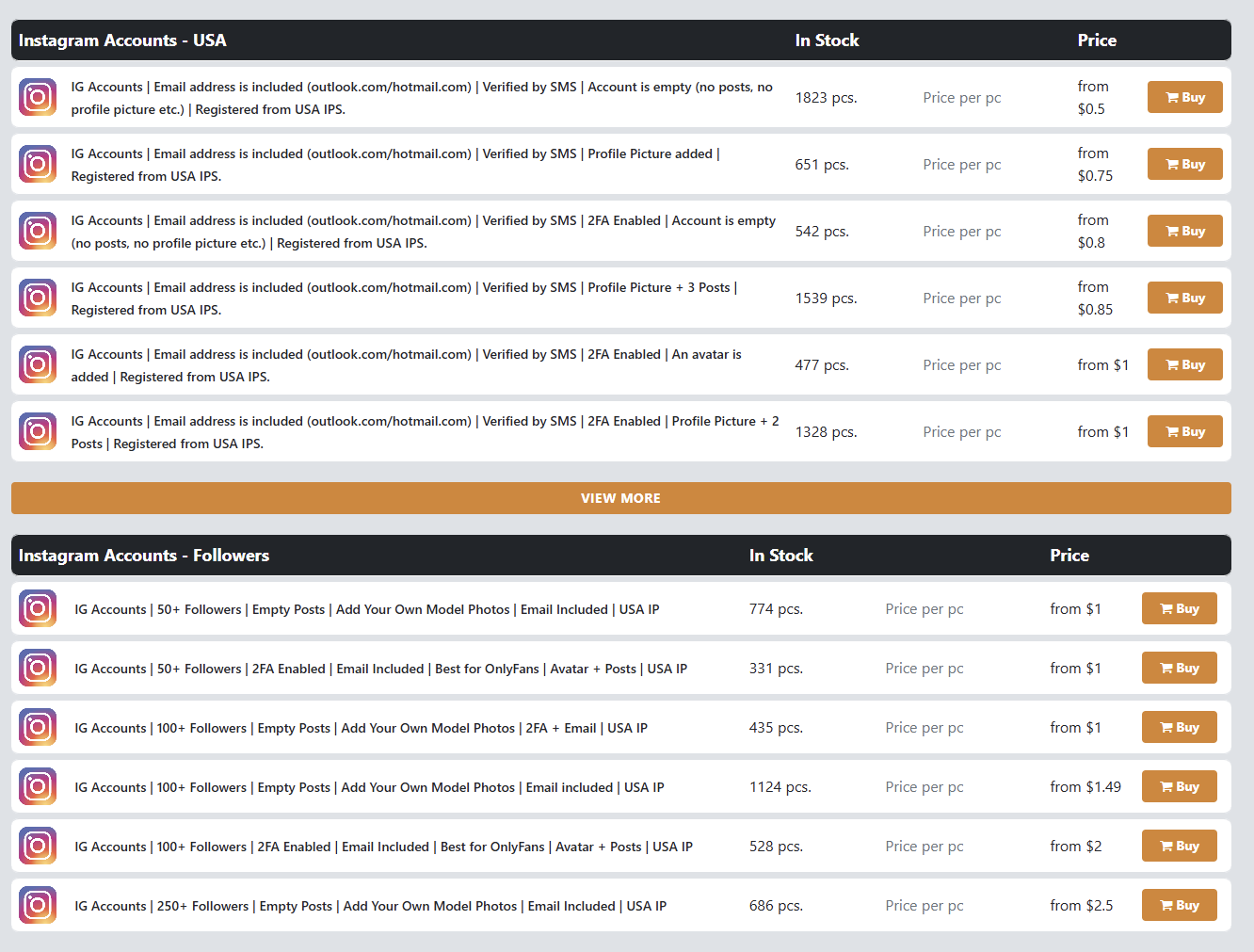
Buying social media accounts used to be a back-channel activity. You’d find someone on a Telegram group, send a wire, hope the account worked, and accept that roughly one in five purchases would arrive broken with no recourse. That market has changed a lot over the last two years. Meta has tightened verification on Facebook and Instagram, Google now demands ID checks on Ads accounts that look new, and TikTok throttles ad spend on profiles without history. Agencies, dropshippers, affiliate marketers, and SMM operators all need accounts that already look established, and they need them on a Tuesday for a Friday launch. The result is a real marketplace economy with several legitimate platforms, dedicated support teams, automated delivery, and crypto checkout.
This guide ranks the eight platforms worth considering, what each one does well, and where each falls short.
Specialist marketplaces now organize inventory by country, account age, and verification tier rather than by follower count alone.
How we reviewed them
Three criteria mattered. First, inventory depth: does the platform actually stock the geo, age, and verification level a buyer needs, or does it just claim to. Second, account quality and replacement terms: are accounts produced under controlled conditions or resold from anonymous suppliers, and what happens when something arrives broken. Third, payment and delivery infrastructure: crypto and card support, automated provisioning, and whether there’s a human reachable when things go wrong at 3 a.m.
Each platform below was evaluated against those three filters.
Why people buy accounts
Most buyers fall into one of four buckets. Media buyers running Meta Ads want aged Facebook profiles because the algorithm restricts spend and campaign launches on accounts younger than a few months. Aged profiles with clean histories get higher daily spending limits faster, which is the difference between a campaign that scales and one that stalls.
Affiliate marketers running multi-account operations across regions need volume. Ten or fifty matching accounts per geo, ready to deploy through an anti-detect browser stack. SMM agencies need Facebook Marketplace access for regional retail clients, and Meta gates Marketplace behind trust signals that fresh registrations cannot pass. There’s also a quieter group of dropshippers and ecommerce sellers who need Business Manager-activated profiles to run ad accounts without the manual ID verification that Meta now demands on brand-new signups.
Warming an account from scratch to passable trust takes three to six weeks of careful activity. Agencies on a deadline don’t have those weeks, which is what’s driving the buy-side demand.
The 8 best marketplaces to buy and sell social media accounts
1. Flippa
Founded: 2009 · Account types: business social accounts attached to website and online business listings · Inventory size: thousands of bundled assets at any time
Flippa is the most recognizable digital-asset marketplace on the internet, and that visibility is both its strength and its limitation for this category. Social media accounts on Flippa almost never appear as standalone listings. They come bundled with a content site, an ecommerce store, or an online business that the seller is exiting. For buyers acquiring a niche-aligned audience attached to revenue, the bundling adds value. You get a content engine with a built-in distribution channel rather than just a follower count.
For pure account inventory, however, Flippa is the wrong tool. Listings are unvetted, due diligence falls on the buyer, and prices reflect the bundled business value rather than the standalone account value. The platform works for an investor sourcing a 200K-follower Instagram tied to a profitable affiliate site. It does not work for an agency that needs fifty Gmail accounts before lunch.
Pros
- Largest unvetted marketplace by listing volume
- Social accounts often bundled with revenue-generating assets
- Strong escrow integration through Escrow.com
- New listings post weekly
Cons
- Accounts rarely sold standalone
- Buyer-side due diligence is heavy
- Wrong fit for bulk inventory needs
Best for buyers acquiring a single high-value asset bundled with an online business.
2. AccsZone
Founded: 2023 · Account types: Facebook (PVA, aged, follower-tier, Business Manager, Real User Profiles, Marketplace-enabled, Dating), Instagram, Gmail, Google Ads, YouTube channels, LinkedIn, TikTok, Twitter/X, Reddit, Telegram, WhatsApp, Threads, plus dating, finance, email, and service categories · Inventory size: 50,000+ in-house across 40+ categories
AccsZone runs on a different model than most platforms reviewed here. Rather than operating as a third-party marketplace where individual sellers list inventory and the site collects a fee, AccsZone produces accounts in-house. Every Facebook, Instagram, Gmail, and LinkedIn profile is registered using country-specific IPs, real phone numbers, and mobile proxy infrastructure that the platform manages itself. Account quality is consistent in a way the open-seller marketplaces struggle to match.
The Facebook catalog is the deepest of any platform reviewed. It breaks down into fourteen sub-categories. PVA accounts for Marketplace posting start at $0.80 per piece. Marketplace-enabled accounts with 2FA and SMS verification start at $1.15. Business Manager-activated profiles ready for ad spending begin at $0.75. Follower-tier accounts come in 100, 1000, and 5000+ tiers. At the premium end, aged USA Facebook accounts from 2007 to 2015 with 1000 to 2000 real friends and original Gmail access start at $700 per piece. Geographic coverage spans the USA, UK and Europe, Latin America, North America and Oceania, Asia Pacific, and the Middle East and Africa, each with country-specific IPs.
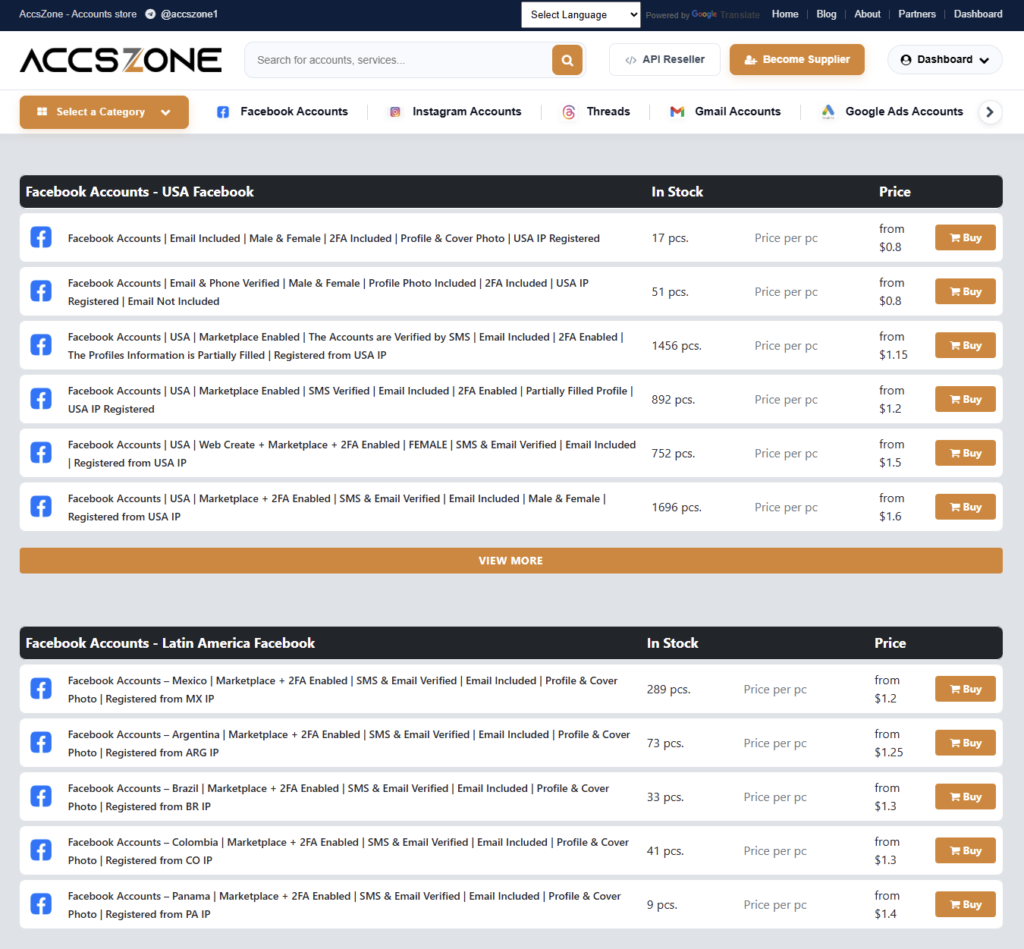
AccsZone’s Facebook inventory breaks down into 14 sub-categories including PVA, aged, Business Manager-activated, and follower-tier accounts.
Beyond Facebook, the platform stocks Instagram across USA, Europe, and Asia at follower tiers from $0.50 to $2.50 per piece. Other categories include Gmail (aged, SMTP-configured, YouTube-linked), Google Ads accounts, YouTube channels with view and video histories, LinkedIn (verified, aged, with connections), TikTok, Twitter/X, Reddit, Discord, Quora, Telegram, WhatsApp, Threads, Bluesky, Truth Social, Snapchat, and Pinterest. The dating app stack covers Tinder, Bumble, Badoo, eHarmony, Taimi, MeetMe, Grindr, and Waplog. Trustpilot, Binance, CashApp, Apple ID, Amazon, Etsy, and Craigslist round out the consumer-account side, and a complete email-provider set includes Yahoo, Outlook, Protonmail, GMX, Zoho, AOL, Web.de, and Onet.pl. Service categories add mobile proxies, premium VPN, Windows VPS and RDP servers, and gift cards from Apple, Google Play, PlayStation, Steam, and Amazon.
Delivery is automated and instant after payment. Checkout supports crypto through Cryptomus along with card payment. Replacements are handled directly by 24/7 human support rather than routed through a third-party dispute system, which matters when something arrives broken on a weekend. An API reseller program and an open supplier marketplace under a 50% commission split sit on top of the consumer storefront, suggesting the platform is designed for ongoing operator use rather than one-off purchases.
Pros
- In-house production gives consistent account quality
- Deepest Facebook catalog of any platform reviewed (14 sub-categories)
- Aged inventory spanning 2007 to 2026 with original email access
- Instant automated delivery with crypto and card support
- 24/7 human replacement support, no third-party dispute layer
Cons
- Premium aged tiers carry a premium price
- Replacement window requires buyers to verify within 24 to 72 hours
- Platform-held guarantee rather than external escrow
Best for media buyers and agencies that need consistent quality across a wide category mix and want a single supplier they can rely on weekly.
3. SWAPD
Founded: 2012 · Account types: YouTube channels, Facebook pages and groups, Instagram, TikTok · Inventory size: hundreds of active listings on the marketplace forum
SWAPD runs a vetted-member forum rather than an open marketplace. Membership is free, but applications get screened. The result is a buyer and seller pool that’s noticeably cleaner than the open competition. Listings tend toward higher-value assets: established YouTube channels with monetization history, Facebook Groups with engaged audiences, large Instagram accounts in commercial niches.
Access friction comes with that vetting layer. Internal search and filtering can struggle when buyers need something specific, like a 50K-follower fitness Instagram with US engagement. The escrow flow works but is less clearly documented than competitors built around automated checkout. For high-ticket single-asset acquisitions where trust matters more than speed, SWAPD remains one of the more reliable options online.
Pros
- Vetted membership filters out the worst actors
- Strong reputation for high-value asset transactions
- Reliable native escrow
- Long public record of successful deals
Cons
- Application approval required
- Weak filtering for specific account types
- Not built for volume orders
Best for premium single-asset buyers who prioritize trust over speed.
4. Z2U
Founded: 2015 · Account types: game accounts, in-game currency, social media accounts across major platforms · Inventory size: extensive, biased toward gaming
Z2U is a generalist digital-goods marketplace where social media accounts share shelf space with gaming inventory, virtual currency, and digital service listings. The platform uses a seller-rating system with platform-held escrow. Buyers pay into Z2U, sellers deliver, and funds release on buyer confirmation. The breadth is useful for buyers sourcing across categories from one account.
For pure social work, the depth doesn’t match what specialists offer. Instagram and Facebook listings are thinner than dedicated platforms provide, country-level filtering is rough, and seller quality varies. Buyers already using Z2U for game accounts will find it convenient to pick up social profiles in the same checkout.
Pros
- Multi-category breadth
- Platform-held escrow on every transaction
- Multiple payment methods including crypto
- Established seller rating system
Cons
- Gaming bias means thinner social inventory
- High seller-quality variance
- Country-specific filtering is limited
Best for buyers already sourcing gaming inventory who want to consolidate suppliers.
5. AccsMarket
Founded: 2017 · Account types: Instagram, Facebook, Gmail, Twitter, Reddit, TikTok, plus various email and gaming accounts · Inventory size: extensive across tiers
AccsMarket leads the category on raw inventory volume. It’s also the most-cited specialist marketplace in industry coverage. Inventory sits across four tiers. Auto-registered accounts at the lowest price point. Aged accounts. Promoted or grown accounts at the high end. And Real User Profiles, which are accounts previously used by genuine users who lost access. Purchase doesn’t require pre-registration, which lowers friction for one-off buyers but means the platform doesn’t track buying patterns to improve recommendations.
Buyers come to AccsMarket for the inventory depth. If an order calls for 200 of a specific account type and it has to ship today, the catalog usually has it when no one else does. The downside comes from the third-party seller model. Quality varies across suppliers in ways the platform doesn’t fully control, and the replacement window is tight enough that buyers need to test inventory the same day it arrives. For experienced operators who already have a verification workflow, AccsMarket performs well. First-time buyers tend to find it rough.
Pros
- Largest inventory by volume in the specialist category
- Four-tier structure covers most budgets and use cases
- Card and crypto checkout supported
- No registration required for purchase
Cons
- Third-party seller model creates quality variance
- Tight replacement window (24 to 72 hours)
- Buyer-side verification process is essentially required
Best for experienced operators who need volume and already have an inbound verification process running.
6. AccsBulk
Founded: 2023 · Account types: bulk social, email, and messaging accounts · Inventory size: focused on volume orders
AccsBulk specializes in bulk orders for buyers who need fifty or more accounts of the same type from a single supplier. The catalog overlaps with the broader specialist market but is structured around volume pricing and consistent batch quality rather than à la carte selection. Checkout supports crypto, delivery is automated, and the platform runs an open supplier marketplace for resellers who want to offload inventory at scale.
Pros
- Built for volume orders with batch-consistent quality
- Crypto checkout and automated delivery
- Open supplier marketplace for resellers
Cons
- Smaller category breadth than full-service specialists
- Less useful for single-account or low-volume purchases
Best for agencies and operators placing recurring 50+ unit orders against a single supplier.
7. G2G
Founded: 2014 · Account types: game accounts, virtual currency, social and digital service accounts · Inventory size: extensive, gaming-weighted
G2G occupies similar territory to Z2U as a multi-category digital marketplace with strong gaming inventory and a smaller social account section. Escrow runs on every transaction. Seller verification involves actual checks rather than a rubber stamp, and the platform has a longer operating track record than most competitors reviewed. For social account buyers, G2G works as a backup source when specialist platforms are out of stock on a specific geo or tier rather than as a primary supplier.
Pros
- Long operational track record and strong reputation
- Reliable escrow on every transaction
- Seller verification involves actual checks
- Multiple payment methods
Cons
- Social media account selection is limited vs specialists
- Country-level filtering is rough
- Better known for gaming than for social
Best as a backup source when specialist marketplaces run out of the geo or tier you need.
8. Sebuda
Founded: recent · Account types: social media accounts with escrow protection · Inventory size: smaller, focused
Sebuda is a smaller dedicated marketplace built around escrow-protected social media transactions. Category breadth isn’t the selling point. The catalog stays intentionally narrow, focused on Instagram and Facebook accounts from verified sellers, with an escrow flow that holds funds until the buyer confirms the account works. For cautious buyers making a first purchase, the escrow protection is worth more than the catalog limitations cost.
Pros
- Built around mandatory escrow protection
- Tight focus on social media accounts only
- Lower-risk entry point for first-time buyers
Cons
- Smaller inventory than the category leaders
- Limited account-type variety
- Less useful for experienced operators
Best as a first-purchase entry point for buyers prioritizing escrow over selection.
How to evaluate an account before you buy
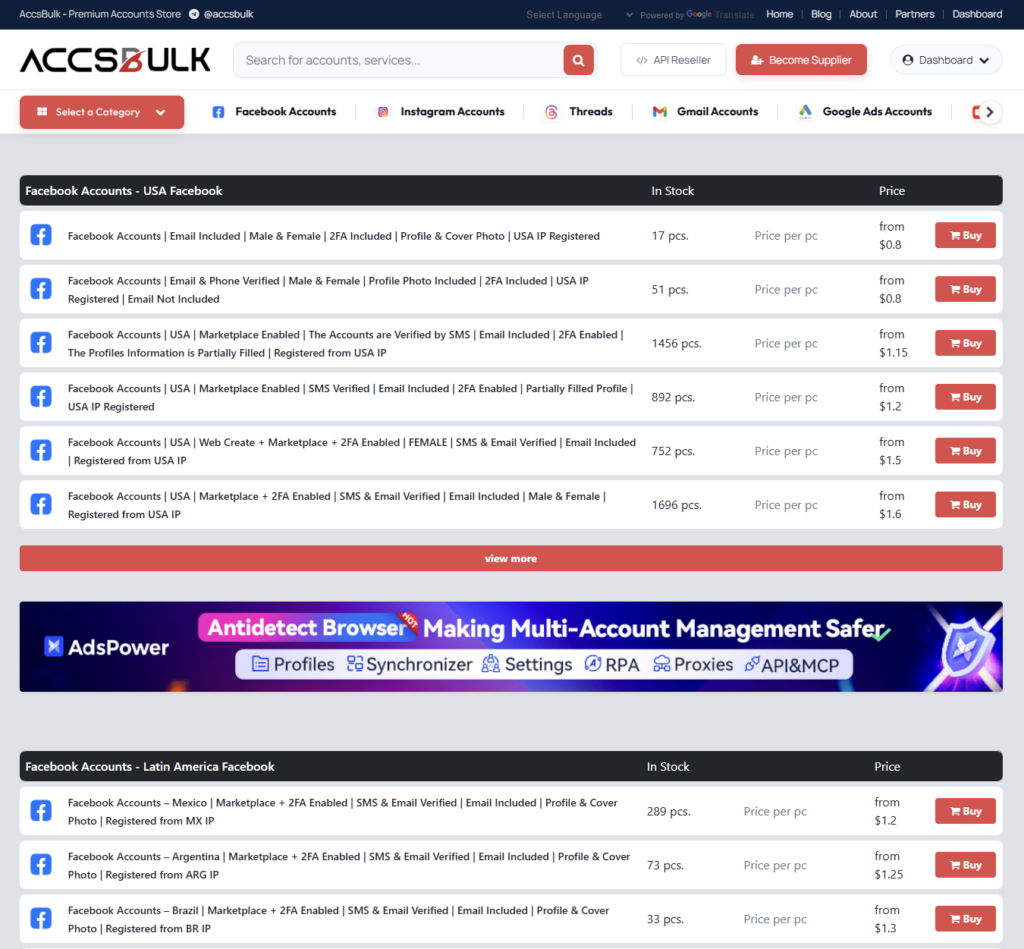
Bulk-focused marketplaces serve buyers placing 50+ unit orders against a single supplier.
The biggest separator between operators who lose money on this category and operators who run it as a steady channel is the pre-purchase check. Run every account through the following list before payment, or right after delivery on platforms that offer a verification window.
- Registration date. Confirm the claimed account age matches what’s visible in the profile. Accounts under three months old don’t behave like aged accounts.
- Email access. The original email needs to come with the sale and needs to be fully transferable, not just the social account login. Without email control, the seller can recover the profile later.
- Country of registration vs. your login geo. Mismatched IPs trigger checkpoints. An account registered on a US IP needs a US residential or mobile proxy to log in cleanly.
- 2FA control. The 2FA seed or key has to be yours, not a phone number the seller controls. SMS access in the seller’s hands means recovery access in the seller’s hands.
- Activity history. Aged and warmed beats aged alone. An aged profile with no posts, no friends, and no reactions looks suspicious to platform algorithms and triggers reviews faster.
- Replacement window. Confirm it before paying. Most platforms run 24 to 72 hours. Test the account the day it arrives.
- Payment method. Pay through the platform’s checkout or platform-held escrow. Don’t wire money to a Telegram contact, regardless of how good the screenshots of past reviews look.
After the purchase
Most preventable bans happen in the first 48 hours after a buyer takes control of an account. Change the password and recovery email immediately, and enable 2FA on your own authenticator app. Then leave the account alone. Updating the password, swapping the recovery email, switching the phone number, and launching an ad campaign within the first hour will look to Meta’s and Google’s anomaly detection like a hack in progress.
Log in through an anti-detect browser or a residential proxy from the same country the account was registered in. Match the geo, ideally the city. Give the account 24 hours of light passive activity like scrolling the feed and reacting to a few posts before doing anything aggressive. Aged and warmed accounts hold value precisely because their behavioral history looks human. Behaving non-humanly the moment you take over is the fastest way to destroy that value.
The takeaway
The right marketplace depends on use case. Flippa for bundled assets attached to real businesses. AccsZone for in-house quality and breadth across forty-plus categories with consistent batch production. SWAPD for premium vetted single-asset acquisitions. AccsMarket for sheer inventory volume when speed beats consistency. AccsBulk for recurring bulk orders. G2G and Z2U as multi-category fallbacks. Sebuda as an entry point for first-time buyers who want mandatory escrow.
The wider story is that demand for established account inventory keeps rising every quarter that Meta, Google, and TikTok tighten their verification systems. Aged and warmed profiles cost more in 2026 than they did even a year ago, and the platforms that handle batch quality reliably are the ones that pick up repeat business from agencies. Buyers who treat sourcing as a workflow rather than a one-time problem tend to stick with one or two suppliers they trust and route everything through them. That’s the real game now.

David Weber is an experienced writer specializing in a range of topics, delivering insightful and informative content for diverse audiences.
I question if this works with larger setups though.
Here is my homepage … สล็อต