
In manufacturing, the product is only half the story. How you package it determines how fast it ships, how much it costs per unit, and how reliably it reaches the customer in perfect condition.
Yet for many small and mid-sized manufacturers, the packaging line is still the most labor-intensive, error-prone, and overlooked part of the operation.
That is where automatic bagging equipment changes the equation.
Whether you produce pet food, fertilizer, hardware parts, snack products, or pharmaceutical powders — automatic bagging equipment can dramatically reduce your per-unit packaging cost, eliminate human error, and free your workforce for higher-value tasks.
This guide breaks down everything a first-time buyer needs to know: what the equipment is, how it works, which type fits your operation, and what to evaluate before spending a dollar.
What Is Automatic Bagging Equipment and How Does It Differ from Manual Packaging?
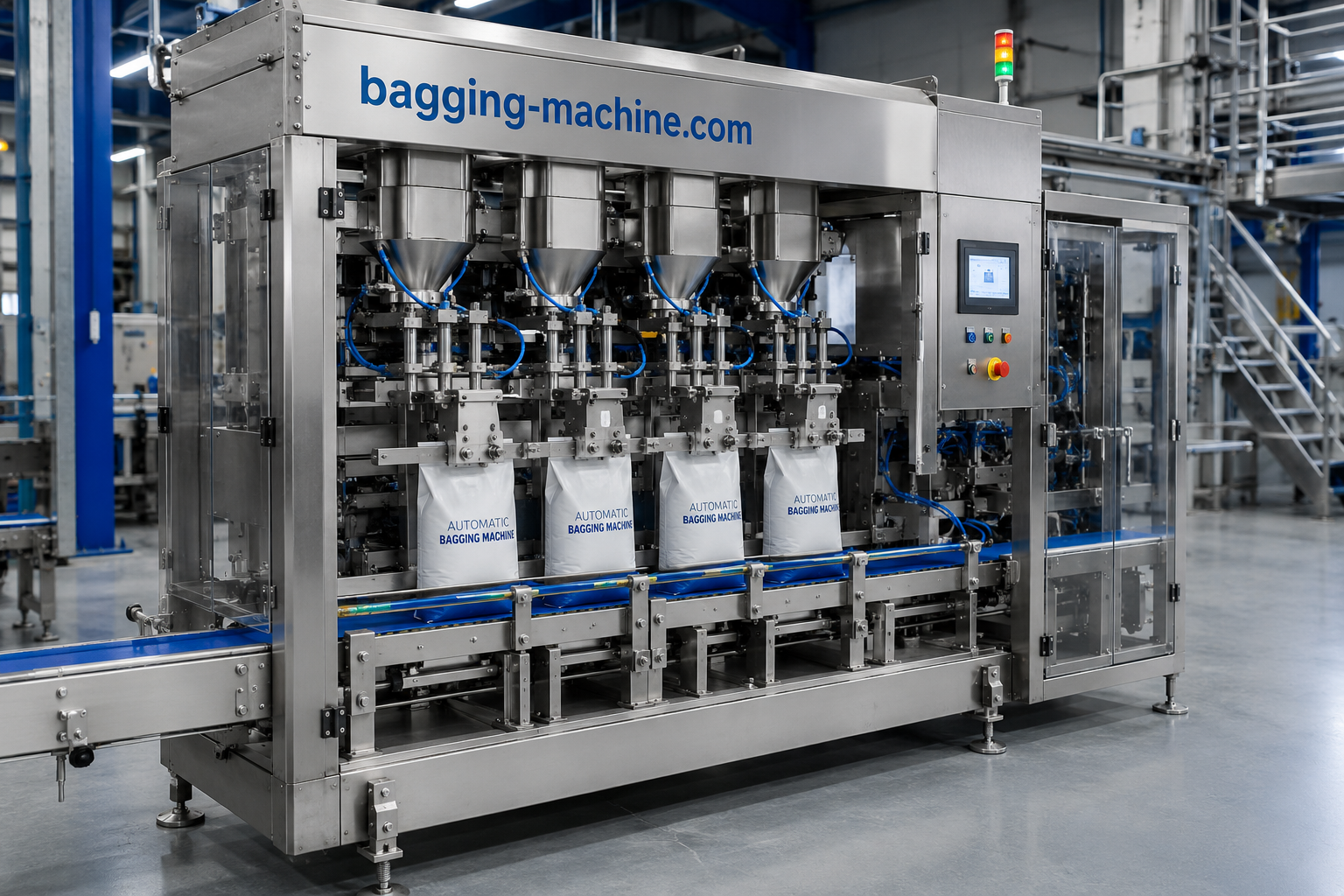
Automatic bagging equipment refers to machinery that fills, seals, and — depending on the model — labels or sorts bags with little to no human intervention. The machine handles the entire packaging cycle: opening the bag, filling it with a precise quantity of product, sealing it, and discharging it onto a conveyor or collection area.
Manual packaging, by contrast, relies on workers to perform each of these steps individually. A worker picks up an empty bag, holds it open under a chute or scoop, fills it by hand or with a basic dispenser, then folds and seals it manually or with a standalone heat sealer.
The differences are not just about speed. They extend to:
- Consistency: A machine fills to the same weight or volume every single cycle. A human does not.
- Output rate: Automatic bagging equipment typically processes between 5 and 50+ bags per minute depending on the model. A trained manual packer averages 3 to 8 bags per minute under ideal conditions.
- Labor dependency: Manual lines are vulnerable to absenteeism, turnover, and fatigue. Automated lines run at consistent output regardless of staffing.
- Compliance: Industries like food, agriculture, and chemicals have strict weight and labeling requirements. Automated systems maintain compliance with built-in weighing and rejection systems.
For manufacturers looking to grow, manual packaging creates a hard ceiling on how much you can produce. Automatic bagging equipment removes that ceiling.
Core Components of a Modern Automatic Bagging System
Understanding what goes inside the machine helps you ask better questions when evaluating suppliers and comparing models. Here are the primary components found in most automatic bagging systems:
1. Product In-Feed System This is how your product enters the machine — typically via a hopper (a funnel-shaped holding chamber) or a conveyor that feeds product from a storage silo or production line. The in-feed system controls the flow of product into the weighing or volumetric measuring unit.
2. Weighing or Measuring Unit This component ensures each bag receives the correct fill. Gravimetric (weight-based) systems use load cells to measure product by weight — common in food, chemical, and agriculture applications. Volumetric systems measure by volume — used when exact weight is less critical or the product flows consistently.
3. Bag Holding and Opening Mechanism For pre-made bag systems, this mechanism grips an empty bag from a magazine or roll, opens it using vacuum suction cups or mechanical grippers, and positions it under the filling spout. For form-fill-seal machines, the bag is formed from a roll of flat film directly on the machine.
4. Filling Spout or Nozzle The spout channels the measured product into the open bag. Different product types require different spout designs — auger fillers for powders, belt or bucket fillers for granules, and piston fillers for semi-liquids.
5. Sealing Unit Once filled, the bag moves to the sealer, which closes the open end. Common methods include heat sealing, stitching, and ultrasonic sealing. The right method depends on your bag material.
6. Discharge Conveyor Sealed bags are discharged onto a conveyor for downstream processing — checkweighing, labeling, metal detection, or palletizing.
7. Control Panel (PLC) A programmable logic controller (PLC) is the brain of the system. It manages timing, fill targets, sealing temperature, cycle speed, and fault detection. Most modern machines include a touchscreen HMI (human-machine interface) for easy adjustment.
Types of Automatic Bagging Machines: Full-Auto vs. Semi-Auto — Choosing the Right Fit
Not all bagging machines operate at the same level of automation. Understanding where your operation sits on the automation spectrum is critical before committing to a purchase.
Fully Automatic Bagging Machines
A fully automatic bagging machine runs end-to-end with zero manual intervention during the cycle. The operator loads raw materials and bags at the start of the shift, sets parameters on the control panel, and the machine handles everything else — opening bags, filling, sealing, and discharging — continuously until the run is complete.
These systems are best suited for:
- High-volume production runs (typically above 8–10 bags per minute)
- Operations running multiple shifts
- Products that are uniform in size and flow characteristics
- Facilities with strict hygiene or contamination requirements
Semi-Automatic Bagging Machines
A semi automatic bagging machine involves the operator at one or more points in the cycle — typically placing or holding the bag while the machine handles filling and sealing. This reduces labor compared to fully manual packaging but retains some human involvement for flexibility.
Semi-automatic options are the right choice when:
- Production volumes are moderate (2 to 8 bags per minute)
- Product variety changes frequently and quick changeovers are needed
- Budget for capital equipment is limited but labor cost reduction is still a priority
- The operation is not yet ready for full automation but wants to move in that direction
Tabletop Bagging Machines
A step below semi-automatic systems, tabletop bagging machines are compact, benchtop units suitable for very low-volume applications, small product batches, or packaging specialty items. They are common in craft food production, laboratories, and small retail operations.
Industrial Bagging Equipment
At the other end of the scale, industrial-grade bagging equipment handles extreme throughput — often 20 to 60+ bags per minute — with heavy-duty construction for continuous operation. These are found in cement, grain, fertilizer, and chemical industries where thousands of bags per shift are standard.
The right choice is not always the most automated option. Match the machine’s output range to your current production volume, leaving room to scale. Buying far beyond your current capacity means paying for automation you will not use for years.
Industries That Benefit Most from Automatic Bagging Equipment
Automatic bagging equipment is not limited to one sector. It has become a standard part of the production line across a wide range of industries:
- Food and Beverage: Rice, flour, sugar, coffee, frozen vegetables, snacks, pet food, and spices all require precise fill weights and hygienic sealing. Automatic bagging systems meet food-grade standards and dramatically reduce contamination risk compared to manual handling.
- Agriculture: Fertilizer, seeds, animal feed, and soil amendments are typically packaged in large bags (10 kg to 50 kg). Automatic bagging equipment handles these heavy, high-volume runs efficiently and reduces strain injuries from manual lifting.
- Chemicals and Pharmaceuticals: Precise fill accuracy is not optional in these industries — it is a regulatory requirement. Automatic systems with integrated checkweighers and reject stations ensure every bag meets specification.
- Hardware and Industrial Components: Nuts, bolts, fasteners, and small parts are counted and bagged automatically using counting machines integrated with bagging systems. This removes one of the most tedious manual tasks on the factory floor.
- Building Materials: Sand, cement, plaster, and aggregates require industrial-grade bagging equipment capable of handling abrasive materials at high throughput without excessive wear.
- Retail and E-commerce Fulfillment: Polybag sealers and tabletop bagging systems are widely used for packaging clothing, accessories, and lightweight consumer goods in fulfillment centers.
If your business produces a product that ships in a bag of any kind, there is almost certainly an automatic bagging solution designed for your application.
Key Metrics to Evaluate Before Buying a Bagging Machine
Before you contact a supplier or request a quote, get clear on these metrics. They will define which bagging machine category you actually need and prevent you from being oversold or undersold.
1. Required Throughput (Bags Per Minute) Calculate your daily target: how many bags do you need to produce per shift? Divide that by your available run time (accounting for breaks, changeovers, and maintenance windows). This gives you your minimum required bags-per-minute rate. Add a 20–25% buffer for growth.
2. Bag Size and Format Specify the minimum and maximum bag dimensions — width, gusset, and length. Also confirm the bag material (polyethylene, woven polypropylene, kraft paper, laminated film) because different materials require different sealing methods.
3. Product Characteristics Is your product free-flowing, sticky, dusty, or hygroscopic? Does it clump? Does it need nitrogen flushing for freshness? Product behavior directly affects which filling mechanism will work reliably. Bring product samples to any equipment trial or demonstration.
4. Target Fill Weight and Accuracy Tolerance Most buyers specify a target fill weight and an allowable error range (e.g., ±0.5%). Check the machine’s rated accuracy under load and verify this with independent testing if possible.
5. Available Floor Space Automatic bagging systems range from compact tabletop units (60 × 40 cm footprint) to full production lines requiring 20+ linear meters. Measure your available space including ceiling height before shortlisting models.
6. Power and Utility Requirements Check required voltage, phase, air pressure (for pneumatic systems), and whether your facility’s electrical infrastructure can support the machine without costly upgrades.
7. Total Cost of Ownership (TCO) The purchase price is only one number. Factor in installation, training, spare parts availability, maintenance contracts, and expected downtime costs. A cheaper machine with poor local support often costs more over three years than a premium machine with strong after-sales service.
8. Regulatory and Certification Requirements Depending on your industry and export markets, you may need CE marking, FDA compliance, ATEX certification (for explosive dust environments), or other standards. Confirm the machine’s certifications before purchasing.
Common Mistakes Beginners Make When Selecting Bagging Automation
First-time buyers make the same errors repeatedly. Knowing them in advance saves time, money, and frustration.
- Buying for today’s volume, not tomorrow’s. If you are currently producing 3 bags per minute but expect to triple output in two years, buy a machine rated for 9–10 bags per minute now. Upgrading machines is expensive and disruptive.
- Ignoring product testing. Never purchase bagging equipment without running your actual product through a machine trial. What works for dry rice may fail completely with a sticky powder or irregularly shaped granule.
- Underestimating changeover time. If you package multiple SKUs with different bag sizes or fill weights, changeover time between runs is critical. Ask specifically how long a full changeover takes and whether tools are required.
- Overlooking after-sales support. A machine that breaks down and takes three weeks for a spare part to arrive from overseas will cost you more in lost production than you saved on the purchase price. Prioritize suppliers with local or regional service engineers and readily available parts.
- Focusing only on speed. A machine that runs at 20 bags per minute but only achieves 85% accuracy will generate more waste and compliance risk than a machine that runs at 12 bags per minute with 99.8% accuracy. Fill accuracy matters as much as speed.
- Not accounting for integration. Your new bagging machine does not exist in isolation. It needs to connect to your existing production line, upstream equipment, and possibly your ERP or warehouse management system. Plan for integration from day one.
- Skipping operator training. Even the most intuitive touchscreen interface requires proper operator training. Budget for it and insist on it as part of your purchase agreement.
Summary
Automatic bagging equipment is one of the highest-ROI investments a manufacturing business can make when the timing is right. It reduces labor dependency, improves fill accuracy, increases throughput, and sets the foundation for a fully automated production line.
The key is matching the right type of machine — tabletop, semi-automatic, or fully automatic industrial — to your specific product, volume, and budget. Start with an honest audit of your current packaging output and cost per unit. Then use the metrics outlined above to define your requirements before speaking to any supplier.
When you are ready to evaluate options, request a live demonstration with your own product, ask for detailed TCO documentation, and verify after-sales support before signing anything.
The right automatic bagging equipment does not just speed up your packaging line. It transforms it into a competitive advantage.

At Engrnewswire, we are passionate about helping brands grow through smart SEO, GEO, and AEO strategies, supported by High-quality backlinks. With over 2k+ contributor accounts worldwide. We ensure your content reaches the right audience while building lasting authority.