
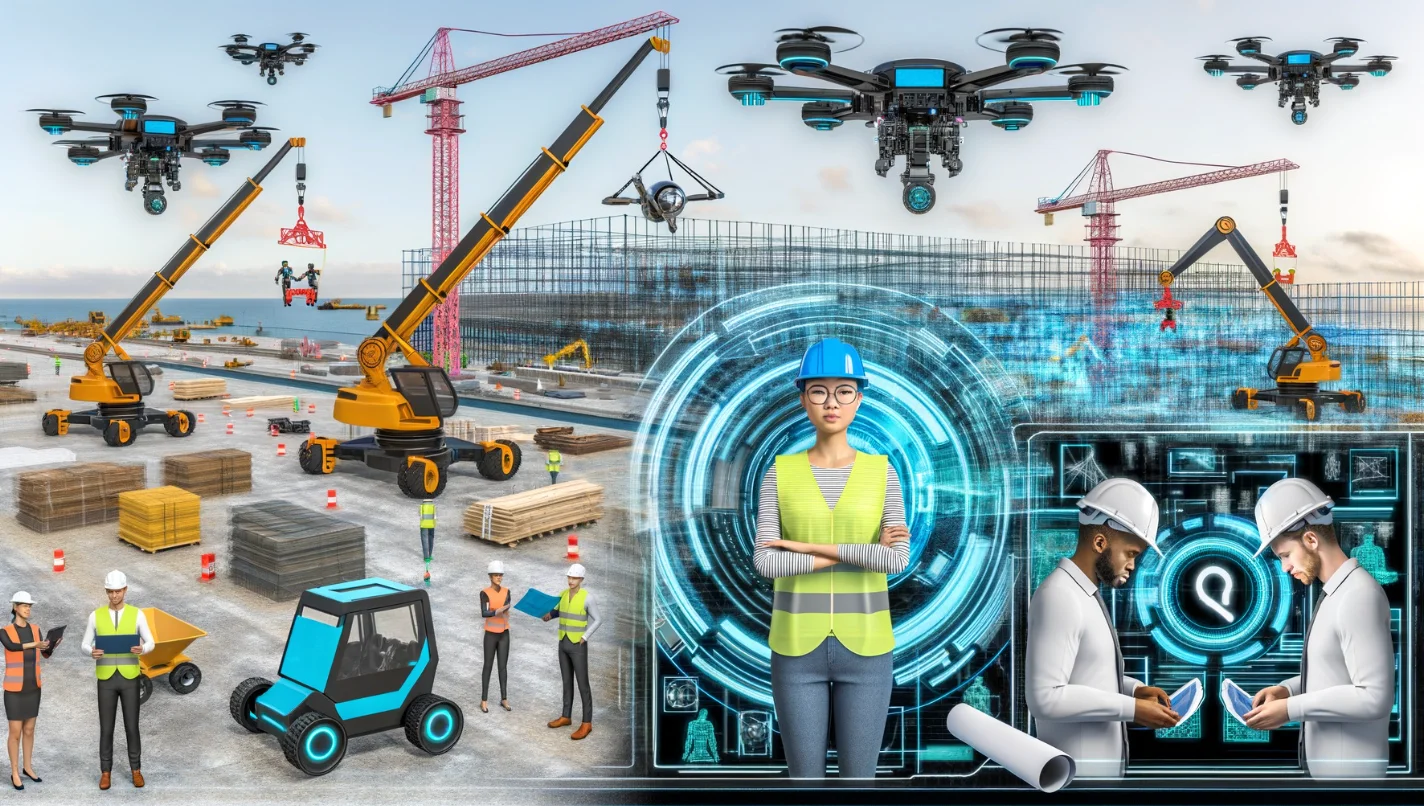
The construction enterprise is on the precipice of a digital renaissance, driven by the quick evolution of computational AI fashions. For a few years, the arena come to be defined with the resource of guide hard paintings and bodily blueprints, however nowadays, facts has end up the maximum valuable useful resource at the technique net net web page. By leveraging tools and getting to know advanced algorithms, advanced businesses are really capable of achieving results, optimizing assets, and scaling their operations with a level of precision that was formerly not possible. This shift isn’t always pretty, a lot faster construction; it’s far more about growing a smarter, more sustainable foundation for the future of world infrastructure.
The Dawn of Algorithmic Project Governance
Computational AI is reworking undertaking management from a reactive problem into a proactive one. Traditional challenge oversight frequently relied on ancient anecdotes and subjective reporting, which often introduced delays and rate range overruns. Modern AI models can devise tens of millions of information factors—from weather patterns to network hardware availability—to create fairly accurate simulations of undertaking lifecycles. This allows stakeholders to visualize the effect of every desire earlier than a unmarried brick is laid.
By using “Digital Twins” and neural networks, contractors can now run hundreds of “what-if” conditions. If a supply chain disruption takes place in some other part of the area, the AI version immediately calculates the ripple effect on the neighborhood website and indicates optimized workarounds. This algorithmic governance reduces the noise of uncertainty, making sure that assignment momentum is maintained irrespective of outdoor volatilities. It is the engine within the lower back of a latest era of predictable, high-increase advent.
Enhancing Material Intelligence with Neural Networks
In the world of wood-framed manufacturing, the capacity to quantify materials successfully is the distinction between an immoderate-margin undertaking and a financial drain. When a lumber takeoff service is generated through a computational AI model, it involves more than easy arithmetic. The AI analyzes the structural loads, architectural nuances, or even the grain orientation of the wood to make sure that each linear foot of wood is used to its full ability.
This level of cloth intelligence minimizes on-site waste, which could be a massive contributor to each environmental effect and misplaced income. AI-pushed systems can routinely nest additives to lessen off-cuts or maybe are awaiting the moisture content of cloth adjustments throughout transit to ensure the timber stays structurally sound upon arrival. By embedding AI into the very fabric of fabric quantification, developers can collect a “lean” collection that is as green as it is sturdy.
Predictive Analytics for Mitigating Site Risk
Safety and risk control have traditionally been the most difficult variables to govern on a production website online online. However, computational AI fashions in the meantime are becoming used to analyze real-time video feeds and wearable sensor data to pick out potential dangers in advance, so that they do not result in accidents. By recognizing styles in worker motion and system operation, AI can flag immoderate-threat behaviors or gadget fatigue, permitting managers to intervene right now.
Beyond physical safety, AI moreover mitigates economic threats by identifying structural failures or layout flaws in the pre-production section. Using generative design, AI can recommend opportunity structural configurations that use fewer assets whilst maintaining an equal degree of integrity. This predictive capability turns danger right into a feasible metric, presenting a protection net for every worker’s body and the assignment’s financial stakeholders.
Read More: Dimensional 2×6 Lumber Sizes Applied in Building and Remodeling of Home
Integrating Market Data for Precision Budgeting
The economic shape of an assignment should be as resilient as its bodily shape. This is where professional Construction Estimating services locate their present-day evolution. While the human element remains crucial for nuanced preference-making, AI models offer those offerings with an amazing intensity of market data. Computational fashions can track international commodity charges in real-time, permitting estimators to adjust budgets based on current market fluctuations in response to static, preceding price books.
This synergy between human information and tool pace guarantees that the financial roadmap of an assignment is typically aligned with the truth. Estimating services can now provide “dynamic pricing” models that allow builders to hedge against inflation and supply chain surges. This diploma of financial foresight is crucial for large-scale growth, as it builds the don’t forget critical ability to secure steady funding and satisfy buyers in an unstable economic environment.
Optimizing Labor Workflows through Robotic Integration
The integration of AI would now not stop at the workplace; it’s far shifting without delay into the arms of labor stress. Robotic automation, guided with the aid of computational common sense, is starting to take over repetitive and excessive-strain duties, together with bricklaying, rebar tying, and placement surveying. These robots do not replace human employees but, as an alternative, act as pressure multipliers, permitting professional tradespeople to focus on complicated trouble-fixing whilst the AI handles the heavy lifting.
Computational fashions coordinate the robot gadgets, making sure they perform in concord with human crews. For instance, a robot surveyor can test a floor plate in a single day, feeding the information back into the BIM (Building Information Modeling) device, so the morning group has flawlessly accurate markings organized for setup. This seamless integration of human and device efforts creates a non-stop workflow that appreciably accelerates the overall construction timeline.
Scaling Operations with Data-Driven Partnerships
To in reality acquire sustained general overall performance boom, a creation agency ought to select partners who are as tech-savvy as they are. Collaborating with a specialized Construction Estimating company that makes use of proprietary AI algorithms allows a contractor to scale without the overhead of building an internal statistics technology organization. These groups offer the “highbrow infrastructure” needed to bid on more complicated, high-rate duties with no question.
An outside estimating companion acts as a statistics auditor, ensuring that the portions and charges fed into the task’s computational models are confirmed closer to broader industry benchmarks. This partnership permits a more aggressive expansion approach. When the records are reliable, the danger of scaling too fast is minimized, and the commercial enterprise company can cope with big portfolios while preserving the same degree of net page-diploma overall performance that made them a success in the first place.
The Circular Economy and AI Resource Logic
As the global reputation shifts in the direction of sustainability, computational AI is playing a leading role in the development of the global introduction economy. AI fashions can track the “embodied carbon” of materials, assisting architects in picking out property which have the lowest environmental impact. Furthermore, AI can plan for a building’s eventual “deconstruction,” developing a roadmap for how substances can be salvaged and reused at the end of the structure’s existence.
This beneficial resource, common sense, extends to power intake as well. AI-driven “Smart Buildings” make use of computational fashions to optimize HVAC, lighting fixtures, and water utilization from the on the spot the building is occupied. By thinking about the whole lifecycle of the construction throughout the format and manufacturing tiers, AI ensures that the venture remains an asset to the environment instead of a liability. This is the ultimate benchmark of manufacturing ordinary performance in the twenty-first century.
Final Thoughts
The integration of computational AI into manufacturing is no longer a luxury—it’s a necessity for survival in a modern-day economic system. By specializing in fabric intelligence, predictive safety, and financial precision, the enterprise is, in the long run, breaking free from the stagnation of the past. As those fashions turn out to be more sophisticated, the boundary between the virtual and physical worlds will keep to blur, leading to a constructed environment that is more resilient, green, and capable of assisting the growth of future generations.
FAQs
Q: Will AI update human venture managers in manufacturing?
No. AI is a device designed to deal with fact processing and pattern recognition. Human challenge managers are vital for manipulating, moral preference-making, and navigating the complicated social dynamics of an introductory website.
Q: How does computational AI, in particular, reduce challenge fees?
It reduces charges through casting off material waste, stopping costly redecorations through conflict detection, and optimizing labor schedules to ensure that no time is wasted on the website.
Q: Is the AI era too steeply priced for small production groups?
Many AI tools at the moment are available through cloud-based, totally SaaS (Software as a Service) models, making them available even to small-to-medium groups. Additionally, the ROI from decreased waste and quicker delivery often covers the fee of the technology.
Q: What is generative layout in creation?
Generative layout is a technique in which an AI version explores lots of layout possibilities primarily based on particular constraints (like budget, material, or weight) to discover the maximum green structural answer that a human might not have considered.
