
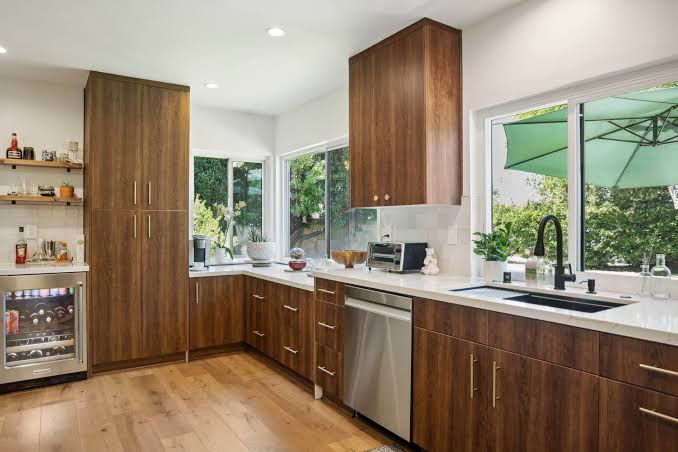
Here’s the honest version of how kitchen remodel planning usually goes. You get inspired — a magazine, a friend’s renovation, a real estate listing with a kitchen that made you immediately dissatisfied with your own. You start a Pinterest board. You visit a showroom or two. You call a contractor for an estimate. And then at some point between the inspiration and the estimate, you realize that you don’t actually know what you want in enough detail to make decisions, and the project stalls while you try to figure out where to begin.
This isn’t a failure of enthusiasm. It’s a process problem. Kitchen remodel planning has a natural structure — a sequence of decisions in which each one establishes the context for the next — and most people approach it without that structure, creating a planning process that generates inspiration and anxiety in roughly equal measure without reliably producing a workable plan.
The following is a practical framework for working through that process in a way that actually gets you construction-ready.
Phase One: Define What You’re Actually Solving For
Before any design work happens, the first planning task is a brutally honest assessment of what’s wrong with your current kitchen. Not what you wish it looked like — what doesn’t work about how it functions.
Counter space that’s insufficient for how you cook. Storage that doesn’t accommodate your actual kitchen inventory. A layout that creates traffic conflicts between the person cooking and the people who walk through the kitchen to get somewhere else. Lighting that makes meal prep difficult. A refrigerator that’s in the wrong place relative to where food gets prepared.
Function problems first, aesthetic problems second. A beautiful kitchen that doesn’t work well for how you actually use the space is a design failure regardless of how well it photographs.
This assessment also establishes the scope boundary. Not every kitchen remodel needs to be a full gut renovation. If your cabinets are structurally sound and the layout works, a refacing and hardware update combined with new countertops and appliances might solve 80% of your functional and aesthetic problems at 40% of the cost. Knowing what you’re actually trying to fix prevents scope creep in both directions.
For those living in specific regions like North Central Florida, the local housing market often dictates whether a light refresh or a complete overhaul is the better investment. Understanding the typical layout of homes in the area can help you decide if removing a wall to create an open-concept space is necessary or if simply updating the finishes will suffice. If you are researching specialized local services for kitchen remodeling in Gainesville at https://seanotefl.com/gainesville/kitchen-remodeling/, you can gain a better perspective on how to align your functional goals with the structural possibilities of your home. This localized insight supports a more realistic plan that respects both your daily needs and your property value.
Defining the scope is often the most critical step in maintaining control over the project’s timeline and financial boundaries. While some updates are purely cosmetic, others involve significant structural changes that require specialized expertise to execute properly. For homeowners navigating these complexities, seeking guidance on professional kitchen remodeling at https://seanotefl.com/gainesville/kitchen-remodeling/ can provide clarity on local building standards and design possibilities. Understanding how different project scales impact the overall workflow allows you to prioritize essential functional improvements while staying within your original budget framework. This strategic approach ensures that the final result balances aesthetic appeal with the practical needs of your household.
Phase Two: Establish the Budget Framework
The total budget number is less useful as a planning tool than a budget allocation broken down by category. Before any product selection happens, decide how much of the total is allocated to cabinetry, countertops, appliances, labor, flooring, plumbing fixtures, lighting, and tile.
Two rules that experienced remodelers apply consistently: first, allocate a contingency of 15 to 20% of the total budget for surprises that will emerge during demolition or construction. Second, treat the contingency as reserved rather than available — spending it down on upgrades before construction starts is the fastest route to a budget overrun.
The allocation conversation also forces priority decisions. If the total budget is $50,000 and appliances alone would cost $20,000 to reach the specification level you want, you need to either adjust the appliance budget or adjust another category to compensate. Making these trade-offs explicit during planning is significantly less painful than making them during construction.
Phase Three: Layout Before Everything
Layout decisions — where appliances go, whether the island moves, whether a wall comes down — drive every other decision in the remodel. Making them early, with input from a contractor or designer who can flag structural and mechanical constraints, prevents the costly mid-project changes that happen when layout questions are deferred.
Sketch your existing kitchen dimensions. Map the locations of the sink drain, the gas or electric range hookup, the refrigerator water line, and the range hood exhaust path. These are the constraints that limit layout options without structural changes — and structural changes are expensive enough that they should be consciously chosen, not discovered after you’ve committed to a layout that requires them.
Phase Four: Contractor Selection and Timing
Get at least three bids, but don’t select on price alone. The lowest bid is often the one that’s missing scope items that will come back as change orders once the project is underway. The right questions to ask: How do you handle unexpected conditions discovered during demolition? What’s your subcontractor relationship for plumbing and electrical? What does your project management process look like for client communication?
Check references specifically from kitchen projects of similar scope. A contractor who does excellent bathroom remodels and general repairs is not necessarily the right choice for a full kitchen renovation — the coordination complexity and sequencing expertise required are different.
Timing matters too. Kitchen contractors in most markets are scheduling four to eight weeks out. Factor that into your planning timeline alongside material lead times to establish a realistic construction start date.
Phase Five: Materials With a Decision Filter
By the time you get to material selection, you should have a defined layout, a category budget, and a stylistic direction. Those three elements function as a filter that narrows the options from overwhelming to manageable.
Work in the sequence that respects dependencies: appliances first (because their specs constrain cabinets), cabinets second, countertops third, backsplash fourth, hardware fifth, lighting and flooring in parallel with the above. Decisions made in this sequence almost never need to be revised because of a conflict with a subsequent decision.
Document every selection with the product name, SKU, vendor, price, and lead time. That document becomes your project bible — the reference that prevents the contractor from ordering the wrong item and prevents you from forgetting what you chose when the sample is no longer in front of you.
