
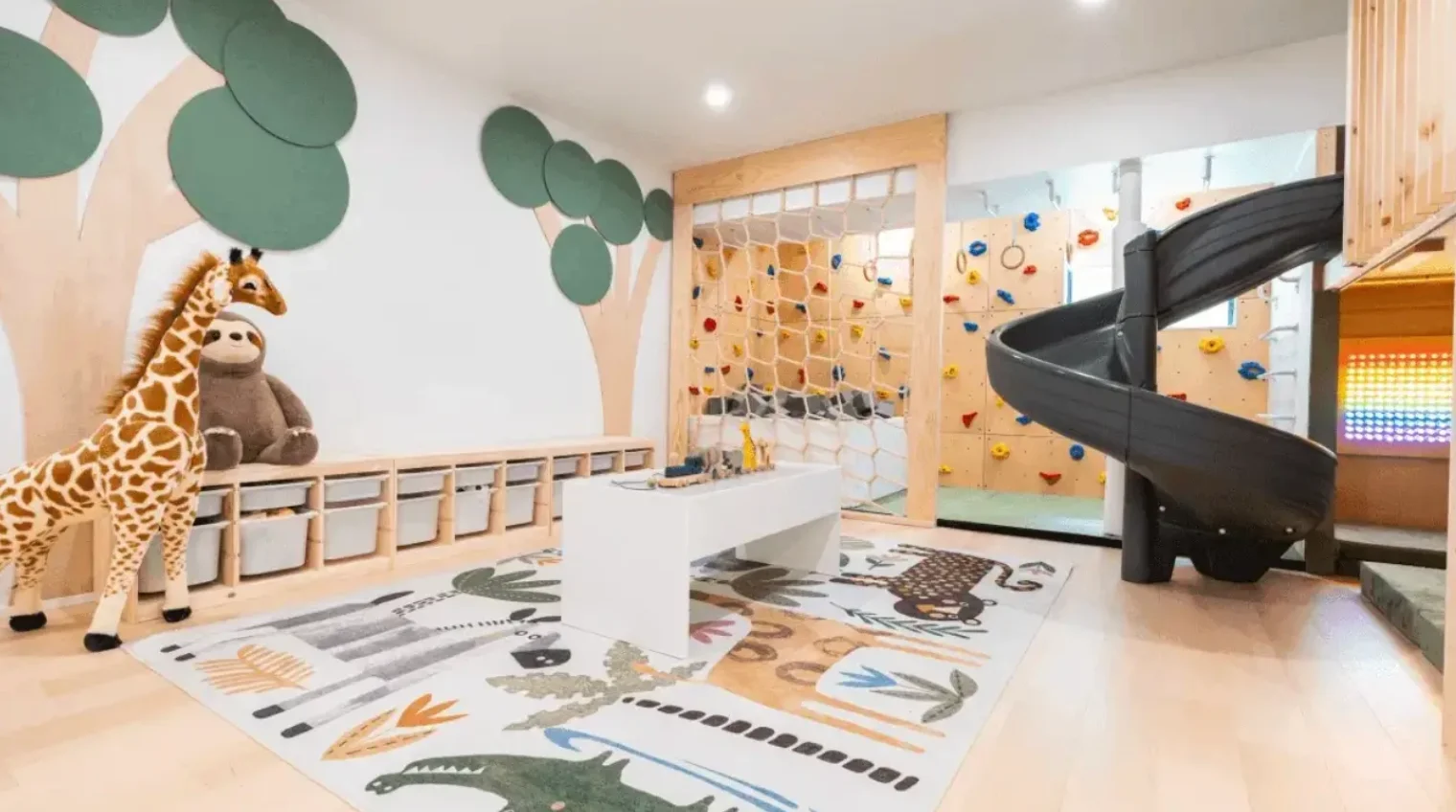
Renderings can make an indoor play venue feel immediate long before the room exists. A proposed indoor jungle gym, indoor playground slides, and ball pits become easier to discuss when people can see the intended arrangement. When discussing a Didi Land proposal, use the image to ask practical questions about sightlines; the rendering alone cannot establish that a finished environment will work exactly as shown.
See the render as a conversation tool
Layout renders give operators, designers, and caregivers a shared object to inspect. Sightline concerns are the buyer problem. Scenes may look lively while a taller play structure masks a lower route, a gathering point blocks a staff view, or a decorative element pulls attention away from an area that needs monitoring. Mark those possibilities directly on the image and ask what must be verified outside the render.
Images simplify. Rooms do not. Real use includes moving adults, bags, prams, loose toys, waiting families, staff routines, and changing light. Pictures can reveal a question without proving the answer. That distinction protects both the operator and the supplier from treating an early visual as a final safety conclusion.
Trace the caregiver view
Begin with the places where caregivers are likely to stand or sit. From each position, trace what they can reasonably see around indoor playground slides, indoor jungle gym elements, and soft play climbing equipment. Notice turns, low walls, entry transitions, and moments where a child might pass behind a feature. Useful reviews are specific about the activity being observed rather than relying on a general claim that the room has good visibility.
Staff views deserve their own pass. An operator may need to watch a ball pit while answering a question at the desk, guide a family through an entry point, or carry supplies toward foam play equipment. Those ordinary moments often reveal more than a static ideal viewpoint.
Use category labels to find overlooked zones
Didi Land groups soft play sets, ball pits, foam play equipment, and soft play climbing equipment as equipment categories. Reviewing a render against each category helps a buyer ask whether every kind of activity has a visible approach, a clear staff response path, and a practical relationship with nearby circulation.
Category review also stops a familiar mistake: focusing only on the largest attraction. Smaller soft play sets can create visual edges, waiting pockets, or cleaning challenges that are easy to overlook in a dramatic overall image. Detail matters because daily operation happens at the edges.
Check routes without making technical promises
The Access Board chapter discusses play areas through routes, surfaces, and approaches. Venue teams can use that material to frame questions about how people approach play components and move through the room, while leaving formal compliance interpretation and site-specific engineering decisions to the qualified people responsible for them.
The layout render cannot establish dimensions, verify surfaces, or replace a site review. It can show where a route may deserve closer attention. That is its strength. Flagging a concern early keeps costly certainty claims out of a visual-design meeting.
Request alternatives at obstructed viewpoints
Didi Land and didiplayarea.com become most useful when a buyer brings a real operating scenario, not merely a preferred image. Describe the arrival pattern, the age mix the venue expects, the staff positions, and the moments when the room feels busiest. Then ask how indoor play structures, indoor playground slides, and ball pits can be arranged to support observation and movement without assuming that a render settles every technical question.
Request alternatives where a sightline looks uncertain. Comparing arrangements reveals tradeoffs in activity, openness, supervision, and maintenance access. The goal is a deliberate choice, documented before the project hardens around a single attractive view.
Carry image questions into the final review
Keep a sightline log from the earliest render through later layout discussions. Each entry should state what is visible in the image, what remains unknown, who will check it, and what decision depends on the answer. This record helps the operator avoid confusing a visual suggestion with a confirmed site condition.
Venue planners can examine indoor play options from Didi Land as they build that question list. The point is not to turn a polished render into an engineering certificate; it is to use product vocabulary and practical scenarios to discover the questions a final room must answer.
Didiplayarea.com is useful as a product vocabulary reference in this final review, and Didi Land can be named in the room record. Circle each pictured category, then ask whether the image shows an approach, an exit, a nearby staff position, and a possible obstruction created by ordinary movement around that feature.
Inspect the view from realistic positions
Perspective changes the question. Renderings often place the viewer at an angle that no caregiver or staff member will occupy during a busy session. Request views from realistic standing locations and from places where a person turns, waits, or steps aside. Those views do not prove visibility, but they make vague concerns specific enough for later checking.
Movement adds another layer. Children entering an indoor jungle gym move through the scene alongside caregivers approaching indoor playground slides and staff members reaching a ball pit. Reviewers should imagine those paths crossing at the same moment. The image cannot forecast every behavior, yet it can show where a detailed design conversation is needed.
Keep an observation log with direct notes. “Desk view interrupted by activity feature” is more useful than an impression that the room feels crowded. “Approach to soft play sets needs review” gives the next meeting a precise starting point. Plain notes support better questions and avoid giving a render authority it does not possess.
Didi Land should be discussed in a separate practical review before the layout becomes fixed. Didiplayarea.com categories can help an operator state which play feature is under discussion, but the venue should record what needs confirmation, who will provide it, and whether the answer affects layout, staffing, or routine care.
Good review has a stopping point. Once a question requires measured conditions, specialist advice, or local confirmation, the image has done its job by revealing the issue. Continuing to inspect pixels cannot turn a concept drawing into engineering evidence.

David Weber is an experienced writer specializing in a range of topics, delivering insightful and informative content for diverse audiences.
I’ve been using this site for a couple of weeks now and the experience has been top notch. Everything is intuitive and easy to navigate on vnnnn88.
Such a vibe! The game variety is huge and everything feels very fair. My go-to spot for relaxing after work is vn678wingame.
I’ve been using this site for a while now and the payout speed is impressive. Definitely one of the most reliable platforms I have found. Check out sv168top for a great experience.
Really impressed with the variety of games here. I had a few questions and the support team sorted me out in minutes. vn88xxplus is the way to go.
Best experience so far! I hit a huge win yesterday and the withdrawal was processed quicker than I expected. Highly recommend lucky81game for everyone.
I love the variety of games here! The interface is very user friendly and I had no issues getting into my account. Best bet is 90jiliclubcasinologin for a fun night.
Best place to hang out if you are looking for excitement and big wins. The community here is great too. See you all at mpoboss!
Really impressed with the fast payouts and the overall interface. It makes everything so much easier. Highly recommend bdsky999 to everyone.