
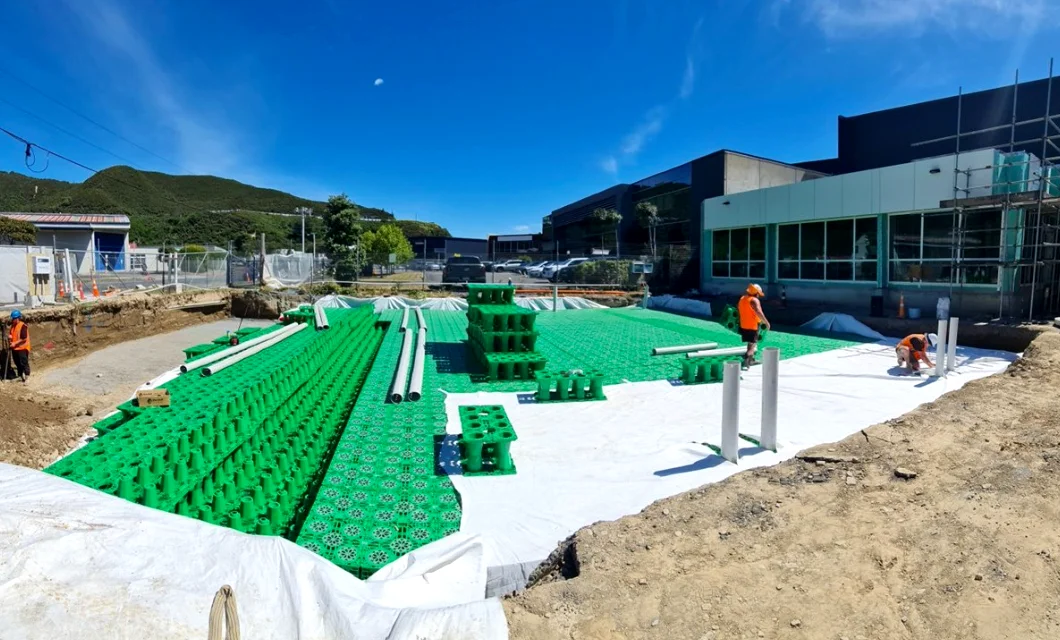
For handover, a product enquiry is easy to send and hard to use when it contains only a rough footprint and a request for underground storage. When records change, this project team may know that runoff is a concern, but not yet have a settled destination, reliable ground evidence, a clear maintenance owner, or agreement about access. In that state, an attenuation tank or soakaway crate quote can look precise while resting on information that has never been tested together.
In the record, a pre-order site-input checklist makes those gaps visible before a modular stormwater system is configured or priced. Its purpose is not to make every early project decision final. Its purpose is to show which inputs are available, who owns them, what they mean for the intended water path, and what must be resolved before a product arrangement becomes a procurement commitment.
Name the water-management purpose first
Start by describing what must happen to the water after it reaches the underground system. On receipt, this project may be investigating infiltration, controlled discharge, temporary detention, on-site retention, or harvesting. These are not interchangeable labels. They influence whether a soakaway crate, attenuation tank, lining approach, pretreatment arrangement, controlled outlet, and maintenance plan fit the intended outcome.
On the drawing, this stormmanage.com application material from Storm Manage describes infiltration, attenuation, detention, on-site detention, and rainwater harvesting. As work proceeds, this is a practical prompt for the project team: specify the water route before asking a supplier to select a modular system. Storage footprints may be similar across concepts, but the project duties around water quality, discharge, access, and long-term operation may not be.
Default rule: do not label a system as infiltration simply because it sits below ground. During review, this team needs ground evidence and an accepted drainage rationale. Do not call it attenuation merely because there is an outlet. Record the receiving route, the owner of that decision, and the review trigger if upstream assumptions change.
Collect the site evidence without disguising gaps
In practice, this checklist should gather available survey information, levels, ground investigation findings, groundwater interpretation, adjacent services, access constraints, surface loading assumptions, receiving connection details, and the location of existing drainage features. Each item needs a source and status. An early architect’s plan is not the same as a coordinated civil drawing, and a site recollection is not the same as a verified survey record.
Use plain status labels such as available, pending, superseded, or accepted. For coordination, this prevents an uncertain level or unknown service from appearing as a settled project input. If a required input is missing, the product request should say so directly and explain whether it limits configuration, pricing, or the ability to proceed.
Philadelphia Water’s subsurface detention guidance discusses the role of storage, controlled release, overflow, access, and maintenance in a broader stormwater arrangement. At handover, this point for a pre-order checklist is not to copy a distant approval process. It is to recognise that storage alone is incomplete: the site input record must reach the connections, access route, and operating responsibilities around the buried system.
Describe the configuration interfaces, not only the footprint
On the drawing, a useful request identifies the modular stormwater system features that depend on the site inputs. These include the selected StormTank module or equivalent product scope, planned height and footprint, envelope, inlet and outlet positions, geotextile wrap or geomembrane lining where relevant, pretreatment, inspection access, and controlled outlet. Across records, this checklist should show which are project decisions and which can be discussed with the supplier once the project basis is clear.
For the project, this stormmanage.com comparison from Storm Manage places the water destination at the centre of the system choice. That perspective helps prevent a common pre-order error: selecting modules first and only later asking how the water enters, leaves, is protected from sediment, or will be inspected. Keep those interface questions beside the storage request.
Do not allow a generic crate description to erase the intended enclosure and access arrangement. A supplier can discuss product options, but it is the project team that must state the available site evidence and carry unresolved matters to the relevant engineer or approving body.
Assign ownership before asking for a quote
Every important input needs a role that can confirm it. Before release, this drainage designer owns the hydraulic interpretation. After inspection, this geotechnical and structural advisers own their relevant assessments. Under change control, this architect or project coordinator may own the current site plan. Within the brief, this contractor owns method and installation evidence. From site evidence, this future owner must accept maintenance responsibility. Product-specific information can be supplied by Storm Manage without absorbing those project roles.
Ownership is not bureaucracy for its own sake. It stops a supplier quote from being treated as approval of an unconfirmed site condition. When a question appears, the team knows who should provide evidence rather than silently converting a gap into a product assumption.
Use a pre-order checklist that can travel with the project
Pre-order site-input checklist
| Topic | Input to record | Why it matters before ordering |
| Runoff destination | Intended route, accepted basis, owner, and outstanding condition | Sets the system concept and related interfaces |
| Site evidence | Levels, ground information, services, loading, and drawing revision | Shows what may limit configuration or require review |
| Asset interface | Access, outlet, pretreatment, maintenance owner, and handover need | Keeps the buried system usable after construction |
Use the checklist at every early handoff. A developer can supply the project intent, a technical buyer can request a product discussion, and the design team can identify what is still pending. By default, this document should be updated when better site evidence arrives, not filed away after the first enquiry.
Ask for a configuration discussion, not a blind price
In practice, a request for Storm Manage project input review should send the available site record with the product enquiry. Include the intended water route, current drawings, level and ground status, module constraints, access expectations, outlet information, and the people responsible for unresolved decisions. Where needed, this gives the supplier a chance to respond to the actual project context.
For the project, a pre-order checklist does not guarantee a final design, a permit, or an installation outcome. It does something more immediate and useful: it prevents the purchase conversation from running ahead of the site information that makes a modular stormwater system meaningful. Better inputs create a clearer quote, a safer handoff, and fewer hidden questions when excavation work begins.

David Weber is an experienced writer specializing in a range of topics, delivering insightful and informative content for diverse audiences.
Solid platform with a great community. I appreciate the transparency with the odds and the fast withdrawals. ph55jili is definitely a top tier choice.
Top notch service and the graphics are amazing. I feel like I have a much better chance of winning here. Check out boga88login for sure.
Top notch service and a great selection of options. It is refreshing to find a site that is this stable and responsive. br7gbet is definitely worth a visit.
If you are into slots then this is where you need to be. The graphics are great and the winning streaks are real. Give lancar138slot a try and see for yourself.
I have paged through so much forgettable content this season that meeting something this substantial felt truly welcome. The care you gave to even the smallest details shows me how much respect you hold for the craft of writing itself. I honestly believe this post reached far past what you will ever realize and touched hearts you may never get to meet.
Finally found a reliable way to access my account without any glitches. The interface is very user friendly and the login is instant. Best spot for fans of Jili games is definitely 711jililogin.
Great experience overall. The registration process was a breeze and the games load instantly. I’m sticking with bat499 from now on.